
* This article is an early version of the introduction to my forthcoming monograph, provisionally titled Plotting Survival: To Live in the Hurricane’s Path.
Find the storm’s swirling core, and understand
— Derek WalcottDerek Walcott, “The Hurricane,” in In a Green Night: Poems, 1948–1960 (London: Cape, 1969). Cited in Sharae Deckard, “The Political Ecology of Storms in Caribbean Literature,” in The Caribbean: Aesthetics, World-Ecology, Politics, ed. Chris Campbell and Michael Niblett (Liverpool: Liverpool University Press, 2016), 25–45, at 25.
This essay attempts to understand how residents of the Eastern
Caribbean island of Waitikubuli,In the Kalinago language, the noun
Waitikubuli means “tall is her body.” This is how the
island’s Indigenous people knew their home when in 1493 Columbus
named it for the Sunday (“Domingo”) on which he happened to sail
past her. (Domingo would become “Dominique” to her French, then
“Dominica” to her English, colonizers.)
otherwise known as Dominica, who inhabit an
animate, 751-kmThough a video of this interview is in the public
domain, I have intentionally anonymized all parties to protect the
parents’ identities here and limit the sense of returning to their
trauma long after the 2021 video was released.
landmass of high volcanic mountains, dense
rainforests, rushing rivers, and unstable soils contend with
cyclones that have the power to spin their worlds into disarray.
Storms that bring pain and loss. That bring regrowth and new
beginnings. These vast meteorological phenomena, with an average
diameter of 500km, bring heavy rains, flash floods, high seas, and
winds as fast as 265km per hour.
Collective lessons from the Surviving Storms research project have prompted me to consider how Dominica’s Afro-creole and Kalinago communities have devised patterns of survival in relation to their animate land, sea and sky, which come alive during storm events. I also explore the long processes of repair that unfold in the storms’ wake. Dominicans face seasonal storms that are carried nearly 5,000km to the Caribbean by the Atlantic trade winds from Western Africa (lands from which most islanders’ ancestors were trafficked). What emerges is an ethic of survival in response to catastrophe that is historically tied to another kind of survival: surviving the catastrophic conditions of the plantation system, brought by Europeans to the Antilles as they moved with those very same trade winds.
In what follows I sketch out an ethics and practice of survival using archival examples, ethnographic accounts, and oral histories gathered during the Surviving Storms project. I pull from across the project to introduce survival plots, an organizing concept that gives name to a survival praxis that has become visible to me. It refers to the storytelling, everyday patterns of worldmaking, and insurgent acts that make post-hurricane and plantation life livable in the Antilles. Survival plots speaks to a place-based, cosmologically grounded, and autonomously Caribbean art of survival. Below, I work through the many meanings of the English noun “plot” (as place, or patch of ground; as story; as secret scheme) and verb “to plot” (to make a place; to storytell; to scheme; to plan) to show how each is animated by Dominican survivals. I begin by offering three plots that demonstrate this polysemy.
Plot I – Towards Safer Ground
On September 18, 2017, Hurricane Maria brought torrents of
rain, wind, and surging seas to Dominica. Four years on, a mother
and father sit on their front step.An everyday mesolect in the island’s complex
linguistic intersystem, with its English vocabulary and
Afro-Creole syntax, punctuated by francophone Kweyol
phrases.
The river rushes beneath a bridge next to their
bayside home, weaving its way towards the Caribbean Sea. Maria
brought pain and loss to this mother and father. That night the
river raged, carrying logs and branches from the interior. It
covered roads and moved vehicles. Debris accumulated beneath the
bridge and, with nowhere to pass, the river breached its banks and
entered their home. With their children they ran outside and
upstairs, towards safety. But amidst the commotion, two of their
children were taken by the floodwaters.
Four years later, in 2021, the international news crews and NGOs have long departed from Dominica. A citizen journalist who rose to prominence for her ground-level documentation of post-Maria life visits the mother and father to check on their wellbeing during hurricane season. Asked how she is keeping, the mother replies:
Today, specifically, is not easy. Because I lost two of them… right here… So, it’s kind of difficult. But I’m trying my best not to relive the sad situation over and over, seeing that I’m in the same space. So, we have to move on. We have other children, so we have to move on. One way or the other.
Both parents live with physical injuries from trying to rescue their children. The family still lives in the same place. They are returned to the trauma of that night it each time thunder claps, rain rattles their roof, or the river “rolls” (grinding large river stones). “Some of my children doesn’t sleep,” she tells the journalist, “like we living the same thing over.”
At the start of the 2021 season, the father cut back thick elephant grass beneath the bridge to reduce the chance of debris accumulating in the river’s mouth and flooding their yard. “The river is a dangerous place to be at the moment, so we just need to come out dere,” he tells the journalist, aware that September (alongside August) is the most active month of the hurricane season.
Ultimately, what they hope for is a safe portion of land where they can live, build, and grow. “We don’t need no house,” he begins,
it not to say we don’t want a house, you know. But, for me and my family, and how I raise and thing, a piece of land for me, and I build a house to comfort my family. So, I seeing it! We sit down there together, we decide on how we building our house, and we do our thing, as a family…
The father is a construction worker, the mother a full-time parent and craft artist. With no savings to buy land and no stable employment for a mortgage, they hope that the government or someone with land will assist them. However, without guarantee of outside help, they do their best to support each other, strengthen their home, and pray for providence: “we just holding our little end, until Father God do something for us.”
Listening again to the interview on the journalist’s social
media channel, I hear the father say something that echoes in my
thoughts: “Four years later! Four years later, we here, doing the
same…, trying to leave/live. Trying, you know, trying to
leave/live.” Spoken in Dominican English,A story gathered as part of the Surviving Storms
past workstream, which employed both a Dominican (Kaila-Ann
Guiste) and British (Anouk Whiting-Ferrolho) intern to scour each
country’s national archives and available secondary source
materials for historical records of storms and survivals. Jenny’s
story emerges from Patullo’s collation of primary source materials
from the Maroon Trials of Dominica (1813–14), held at the British
National Archives. Polly Pattullo, Your Time Is Done Now: The
Maroon Trials of Dominica, 1813–1814 (London/Trafalgar:
Papillote Press, 2015).
both verbs, “live” and “leave,” are homonyms–they
sound near identical. And in the father’s pronouncement, perhaps
with intention, words, sounds, and meanings merge. Thus, to
leave and dwell on safer ground also bears the promise of
a more secure life: to live though storms to come.
Plot II – Jenny’s Journey
In archival materials documenting the Maroon Trials of Dominica
(1813–14),Patullo, Your Time Is Done Now,
115.
there is reference to a woman known only as Jenny,
who had been enslaved on the Hillsborough sugar plantation (one of
the larger and most brutal English-owned estates, situated midway
up Dominica’s west coast). Sometime during the 1813 hurricane
season, Jenny sustained an injury to her leg. She was issued a
pass from the plantation manager and embarked on the eight-mile
walk south to receive medical attention in the capital,
Roseau.
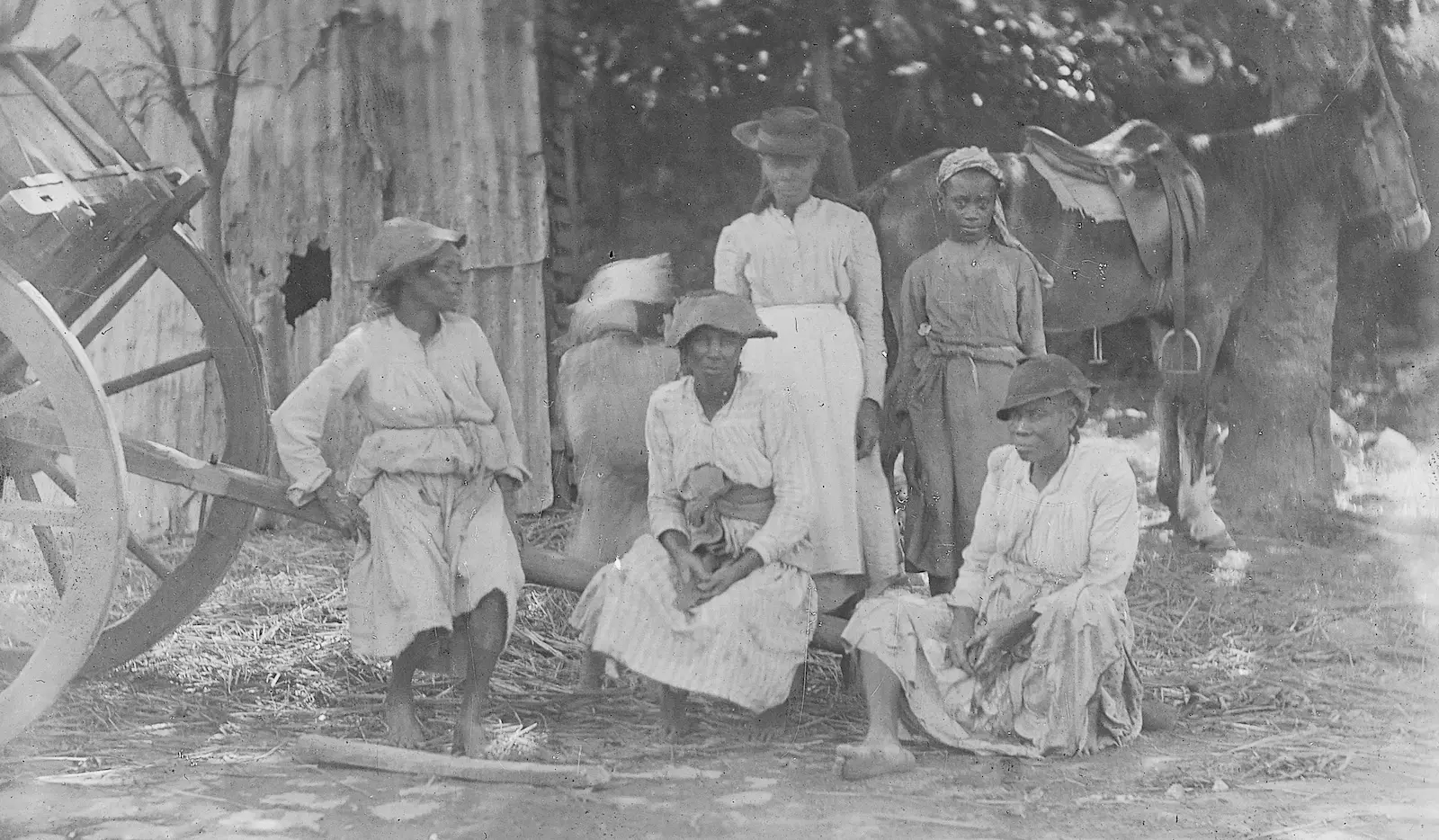
As fate would have it, upon her arrival in town a terrible
Hurricane hit Dominica. In fact, two hurricanes made landfall that
summer: the “overwhelming hurricane” of July 28, as the governor
of the day referred to it, and the “destructive deluge”Lennox Honychurch, In the Forests of Freedom:
The Fighting Maroons of Dominica (London and Trafalgar:
Papillote Press, 2017), 171.
that came almost a month later, on August 25, a
hurricane of torrential rains that “swept through the debris of
the previous disaster, bringing down landslides, blocking rivers
and causing widespread flooding.”Patullo, Your Time Is Done Now, 75–76.
Perhaps he possessed knowledge of local “bush” medicine, or the
spiritual powers of the Gardé Zaffé (“seer of affairs,”
an obeahman/spiritual worker), with which to heal her leg.
The archival records do not state which storm met
Jenny in Roseau, but whichever it was, she was caught up in the
mêlée that temporarily upended this small plantation society. And
here she was led towards a temporary freedom. Jenny stated that in
the hurricane’s immediate aftermath, unable to receive treatment
in town, she began returning north to Hillsborough to have her
pass renewed, before swiftly returning to Roseau for medical help.
Yet on her way she met a man who offered to take her to the
eastern settlement of Castle Bruce (accessed via the mountainous
interior) to finally “get her leg cured.”In collaboration with the I Have a Right
Foundation (https://ihavearight.org),
Dominica Women Farmers’ Oral History workstream is part of
Surviving Storms and led by Dominican sociologist Cecilia Green
(https://survivingstorms.com/tag/farmers/)
However, Jenny claims he led her off into the high
mornes of Dominica’s dense central rainforest. Here she
dwelt for several months in a maroon camp, amongst fellow women,
men, and children who had created a collective world, in refuge
from enslavement.
Eventually, Jenny was captured when a group of rangers (enslaved people promised freedom for killing maroon chiefs), guides (enslaved people who knew the forests), and pioneers (planters) who were searching for maroons sighted a boy harvesting wild yams at the camp’s edge. The boy raised the alarm but was caught along with Jenny and several children and women from the camp. Others escaped into the wilds. Each of those captured would appear in the sham court of bloodthirsty Governor Ainslie, who waged a genocidal war against Dominica’s maroons (1813–14). All captives were “tried,” typically by military commission, without a jury or representation. Many were sentenced to death. Jenny escaped with her life but was returned to Hillsborough, bondage, and whatever punishment awaited her. Her courageous journey into freedom’s forests had ended abruptly. However, it was the confluence of the hurricane’s tumult, timing, and Jenny’s bravery that enabled her to seize the moment, refuse captivity, and plot a path towards the refuge of Waitikubuli’s mountains.
Plot III – Planning and Planting
“I am a retired nurse and always a farmer,” declares Judith,
her abundant backyard garden framing her smile as it slopes away
behind her towards Dominica’s northeastern Atlantic coast. She is
in conversation with two teenagers from a local girls’ rights
group who are undertaking an oral history project amongst women
farmers in their area.Here Judith refuses the crude calculation of
catastrophe. The loss was great, evident, and felt. And with no
farmers’ insurance upon which to claim, to tally it would have
painfully numericized that which was already known yet changed
nothing.
Nurse Judith, as she is respectfully known by her
community, relates memories of farming, nursing, and motherhood
throughout her 63 years of life. Born and raised in the farming
village of Calibishie, her biography entwines various ecologies of
care: the continuous work of nurturing plant, animal, and human
life. Tianna interviews Judith, while Sydney videos their
conversation, occasionally pitching in with questions. They are
interested in how Judith and fellow members of their farmers’
collective (The Northeast Women in Agriculture Movement) have had
their farming impacted by hurricanes. They also want to know how
she envisions the future of Caribbean women’s farming in our
warming world.
“The loss sometimes with the farmers can be great,” she
asserts, citing intensified droughts during the ka wem
(dry season, April–May) and stronger, less predictable storms
during the hurricane season that follows (June–November) as
evidence of the reality of climate change. She speaks of rains
that wash away crops, bring landslides that destroy provision
gardens, and, in the event of category 5 Hurricane Maria, razed
the island’s forests and farms to the ground. After Maria, she
remembers: “my house was uncovered […] my roof everything was
upside down.” And like so many Dominicans who live in two-story
concrete homes and lost wooden roofs to the storm, Judith had to
condemn her upper floor and lived downstairs for a year, until her
roof was repaired. Of her garden—where she grows “ground
provisions” (sweet potatoes, dasheen, tania, yam plantain,
green fig/banana, and cassava), cucumbers, avocado,
guava, breadfruit, and other tree crops—she says the destruction
was near complete. “I don’t want to count the loss!”This is a common pattern amongst Dominican
smallholders (famously documented by Trouillot), whose subsistence
plot secures life against erratic boom and bust cycles of monocrop
exports. Growing up before the decline of bananas (during the late
90s to early 2000s) when Calibishie was “banana country,” Judith
could be described as a “banana child” whose work on a farm would
help to fund her education and support her social mobility towards
becoming a nurse (though she continued to rely on farming to
supplement her salary). See Michel-Rolph Trouillot, Peasants
and Capital: Dominica in the World Economy (Baltimore: Johns
Hopkins University Press, 1988).
And yet, two days after Maria, she tells Tiana, “I had to pick
up everything.” Not yet retired, Nurse Judith returned to work.
“My health center was at the back of my vehicle.” Her jeep became
a mobile clinic from which she administered medicines, dressed
injuries, and gave injections (“get up in the night in the dark…
to give people injection, right here at my home!”). But throughout
this time, much as it had been throughout the previous 35 years of
her nursing career, “my little agricultural plot”—her provision
garden, on a ridge just a short drive from her home—was never far
from her thoughts. This plot and her backyard garden had helped
Judith to “relieve my home budget” and meet her family’s needs
throughout her working life.Michel‐Rolph Trouillot, “Discourses of Rule and
the Acknowledgment of the Peasantry in Dominica, WI, 1838–1928,”
American Ethnologist 16, no. 4 (1989): 704–18;
Honeychurch, In the Forests of Freedom, 204.
This was a hard-won right her ancestors had fought
for post-Emancipation: to gain access to land, control their
labor, and hence secure their subsistence.Kamau Brathwaite offers cosmology as way of
fathoming the cultural-spiritual-historic undercurrents and roots
that animate and anchor Caribbean life worlds. Kamau Brathwaite,
“Note(s) on Caribbean Cosmology,” River City 16, no. 2
(1996): 1–17. My thinking of survival in relation to cosmology
also speaks to Vizenor’s Native North American conception of
“survivance”: as cosmologically rich “ventures of imagination,”
“survivance stories,” and “individual visions” that help to
sustain and remake Indigenous worlds amidst ongoing colonial
catastrophe. Gerald Robert Vizenor. Manifest Manners:
Narratives on Postindian Survivance (Lincoln: University of
Nebraska Press, 1999), 168.
And in times of more acute need, like the immediate
wake of a storm, she returned again to the soil to ensure her
family’s survival.
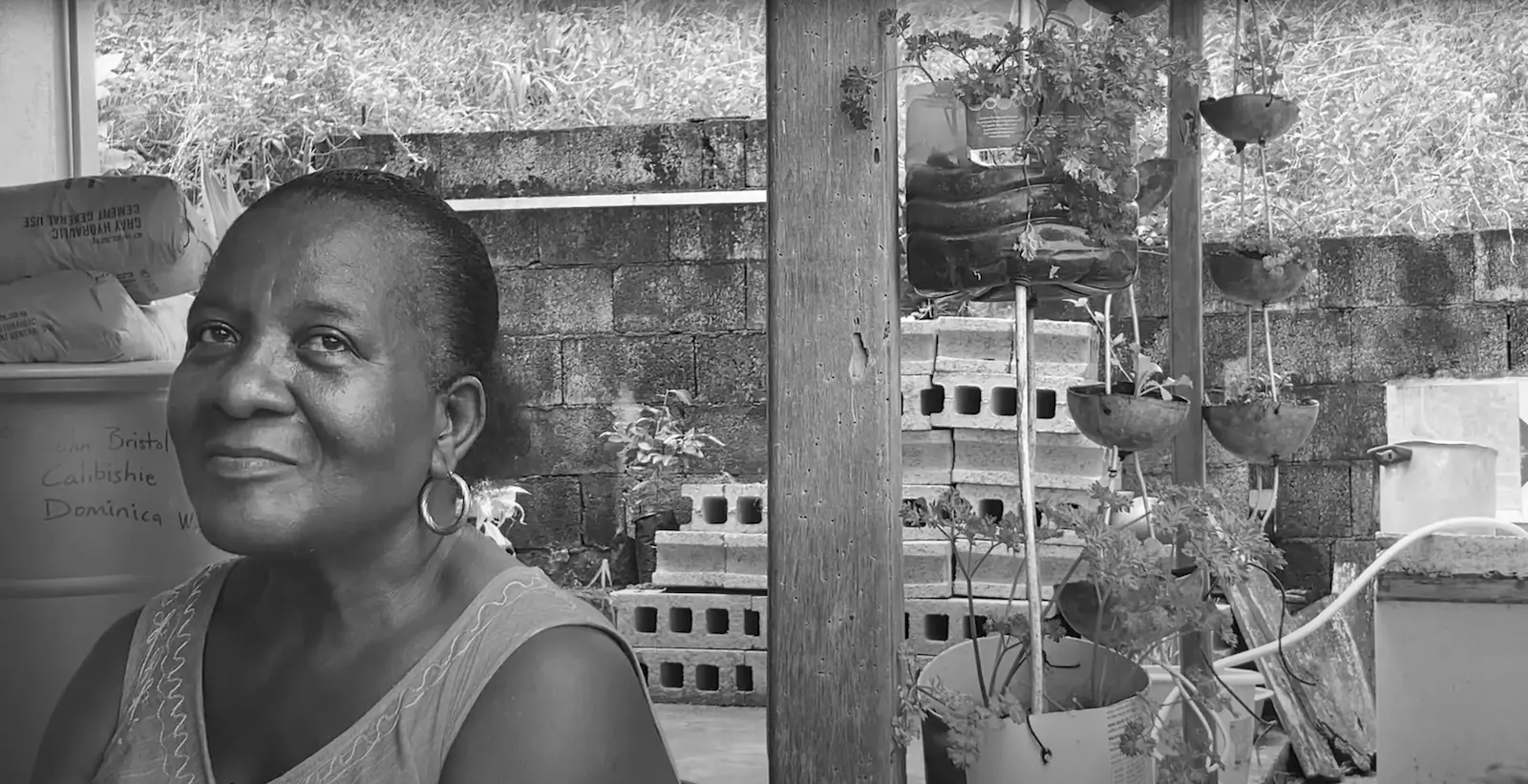
“When everybody crying and running around looking for galvanize” to patch up their roofs, she tells the girls, who listen on intently, she and her son “just sat down and we say, ‘you know what we need to put up a plan… we have to go back on the farm’.” They recruited people from the village to help them cut back fallen trees and branches by cutlass and chainsaw, and to clear the strewn debris by hand. They began re-planting their ground provisions. “We salvaged what [tools] we had, and we could get back to work […] and we kept our farm up. It was very challenging, but we did it.” At home, she retrieved the solar shower heater that Maria’s winds had pulled from her roof and dumped in her yard, the plastic guttering dragged from her roof, and her washing machine, somehow washed from her open porch into the valley below, and she filled them with “dirt.” In these recovered vessels she grew lettuce, cive (spring onion), seasoning peppers and parsley, which she would go on to share with neighbors, sell, and use in her own cooking. So, during the difficult days and months that tailed Maria, Judith returned to her land and a practical art of subsistence that she had cultivated throughout her life.
I call them survival plots, these ways of narrating,
sustaining, securing, and (re) envisioning life in the hurricane’s
wake. I have introduced three overlapping kinds of plot: as
ground, as covert scheme, as plan. First, we looked to grieving
parents who live at a perilous point where river and sea meet.
Parents seeking a plot of land on higher ground, a place to build
a family home and a new beginning. Then the journey of Jenny, an
enslaved woman, who flees a plantation amidst the turbulence of a
nineteenth-century hurricane. Jenny plots a path of
self-possession and fleeting freedom into Dominica’s forested
interior. Third, a nurse and farmer’s swift return to her hillside
garden and house yard, planting provisions, vegetables, and
seasonings to ensure her family’s subsistence in the wake of a
hurricane that damaged her home and razed her crops to the ground.
In calling these varied ways of securing life in the face of
hurricanes survival plots, I am trying to suggest that
there is something powerful, even cosmological, that holds such
patterns of Caribbean survival together.Cecilia Green, “A Recalcitrant Plantation Colony:
Dominica, 1880–1946,” New West Indian Guide 73, nos. 3–4
(1999): 43–71.
I am proposing survival plotting then as
an exploratory framing, born of Caribbean thought and experience,
that seeks to understand the deep cultural currents that have
enabled the peoples of the archipelago to weather recuring
catastrophes. In Dominica, this rugged, untamable land of my
maternal ancestors, I am concerned with how a popular survival
praxis has emerged and how this has enabled the island’s Black and
Indigenous inhabitants to live through storms past, as well as
enabling them to face those that will surely come.
The three plots sketched out above emerged during the Surviving Storms project (2019–23) that sought to understand, document, and share Dominican patterns of hurricane survival with local, regional, and diasporic publics. The project was public facing, multimodal (sound, visual, map-based), and transdisciplinary (intersecting Sociology, Anthropology, Architecture, Art, History, and Earth Sciences). We secured funding from the UK government’s Global Challenges Research Fund, which uses international aid money to generate research that supports UN Development Goals. Our aim was to repurpose such “aid,” often presented as a benevolent gift, to do reparative work in a former British colony. Working from Britain—first at Goldsmiths University in southeast London, then Bristol; two places that grew rich and industrialized through West Indian sugar and slavery—we considered the role that a high-emission country like Britain, that had historically deposited enslaved people in the path of hurricanes today intensified by planetary warming, must play in supporting research that promotes Caribbean survival and repair. As I think back across the arc of the project it becomes apparent that this work not only shares a gathering of valuable practices and experiences, but also proposes a method for doing disaster research guided by social and planetary sensitivity. A mode of social study that is oriented towards ground-level co-research, attentive to ecology and place.
In what remains of this article, I will (a) consider the relationship between hurricane and plantation, the creative survivals their catastrophic convergence birthed; (b) elaborate on the idea of the plot as a theoretical groundwork for grasping such survivals; and (c) close with a tentative consideration of the planetary significance of all this plotting. But first, I will briefly locate Dominica and attempt to situate my analysis in historical and topographic terms.
Waitikubuli. Groundwork
Waitikubuli (Dominica) was the last Caribbean island to be
colonized by a European power. Owing to its mountainous and
densely forested topography, its volcanic landslide-prone soils,
and its many rivers that flood with heavy rains, the island’s
“recalcitrant” landscape resisted the proliferation of large
plantations.Lennox Honychurch, The Dominica Story: A
History of the Island, 3rd ed. (London: MacMillan,
1995).
Between the fifteenth and seventeenth
centuries, as Europe’s plantation machinery cranked into gear
across the region, Waitikibuli became an ecological fortress from
which Amerindians, fleeing other islands, resisted European
incursion.Trouillot, Peasants and Capital,
28.
Likewise, Waitikibuli became home to maroons and
refugees fleeing bondage on the neighboring isles of Martinique
and Guadeloupe, and a motley of French woodcutters, missionaries,
and small planters settled there too. It is in the shadow of the
plantation world that this creolizing society emerged. These early
Dominicans (for this was now Dominica or Domnik, in Kweyol)
survived by the land and sea, without yet a brutal statecraft to
suppress African, Indigenous, and subaltern European cosmologies
and all that will have grown between them.
Here, a relation to the landscape and a spirit of autonomy was
established that both the spread of small-scale French plantation
slavery from the early 1700s and British wholesale surveying of
lands and establishment of a plantation colony from the 1760s
would not undo. The abundance of land enabled independent
cultivation by enslaved peoples on their provision grounds:
marginal, steep plots of land at the plantation’s edge, where
these “proto peasants” grew food (at permitted times) for
subsistence and sale domestically. Such economic activities (labor
and marketing) afforded some potential economic self-sufficiency
amidst the brutal exploitation of chattel enslavement. Likewise,
the abundance of steep rainforested peaks and high ridges kept
open the possibility of “flight to the mountains” for Kalinago who
resisting settler expansion, or African and Creole slaves who
refused bondage, electing to flee to maroons’ camps amongst the
dense vegetation of the island’s high interior.Danielle N. Boaz, “Obeah, Vagrancy, and the
Boundaries of Religious Freedom,” Journal of Law and
Religion 32, no. 3 (2017), 429.
These experiences of living in relation to the elements, not
always bound to the most punitive circumscriptions of daily
life–including being able to express Afro-Creole ritual and
spiritual practices (outlawed by the British much later, in the
late eighteenth century)Honychurch, Forests of Freedom, 1.
—likely opened the way for Dominica’s modern
cosmological foundations to grow. Particularly given that all this
was unfolding in varied degrees of contact and collaboration with
the lifeworlds of Dominica’s Kalinago inhabitants, whom the island
had been all but left to; first de facto, and then de
jure under the Anglo-French treaty of Aix-la-Chapelle in 1748
(that is, until the British colonized the island 15 years later).
The everyday activities of sustaining life—farming, fishing,
interisland trade, constructing homes and boats, and cutting
wood—demanded knowledge of the climate, sea, plants, and soils.
The sharing of Kalinago-African-Creole knowledge of planetary
patterns likely emerged: cycles of the seasons and the growing and
waning moon; how to navigate on water by boat by reading sea
currents, winds, and stars; tracking and hunting marine and forest
life; anticipating the weather by observing the sky and sensing
the atmosphere; reading the temperament of rivers with the coming
of heavy rains. All of this knowledge sustained human life and
established ecological relationships to the island itself.
Dominican historian Lennox Honychurch, drawing on Haitian
historian Jean Casimir, concludes of the present-day traces of
such a history that Dominica, unlike its neighbors, “shows the
effects not so much of a plantation society but of a Maroon
society,” adding that “a late and weak plantation system […]
resulted in a less colonized and thus less regimented and more
open modern society.”Ibid., 206–07.
Profound cosmological connections to earth, sea,
and sky will have taken root in this world, enabling the island’s
inhabitants to sustain life through turbulence and in calm. This
spirit persisted into the British plantation society project (1763
to the mid-twentieth century), into Kalinago establishment of a
semi-autonomous territory (1903), into the naturalist philosophies
of Dreads in 1970s who rejected a neocolonial “Babylon system”
that dominated Dominica’s twentieth-century society and sought
freedom (like their maroon predecessors) in the mountainous “Zion”
(forest gardens),Lennox Honychurch, “Slave Valleys, Peasant
Ridges: Topography, Colour and Land Settlement on
Dominica,“ Proceedings of the University of the West Indies
Dominica Country Conference, Roseau, Dominica, 2001, https://www.open.uwi.edu/sites/default/files/bnccde/dominica/conference/papers/Honychurch.html
and it carries through to the wider
post-emancipation peasant society that had emerged as laborers
left the estates of former captors, developing traditions of
hillside smallholder farming and attachments to “family land” that
persist today. Together, these patterns make Dominica, for all its
imports, one of the most food-secure Caribbean islands, with one
of the most democratic land ownership distributions in the
region.Trouillot, Peasants and Capital,
135.
This sense of the land giving security has carried the
population through many economic storms that have visited the
island’s shores. Dominica’s small plantations and family farms
have long been vulnerable to external shocks. Coffee, cocoa,
sugar, citrus, and bananas: each oriented towards distant
metropolitan markets, moved through cycles of boom and bust. Yet
throughout these histories, and with the decline of bananas at the
turn of the millennium, farmers growing crops for local, regional,
and international markets did so in the confidence that they could
always “eat their fig,” as one of Haitian anthropologist
Michel-Rolph Trouillot’s interlocutors once put it concerning the
use value of bananas in their green starchy form.“Occupational flexibility”: “people tend to grab
opportunities for cash as they appear.” Trouillot, Peasants
and Capital, 49.
This staple was often turned to in times of
hardship, when there was no export market in their yellow form.
The green fig, an abundant ground provision, stands as
symbol of the array of subsistence crops planted alongside cash
crops for household consumption, signifying the basic security the
land affords. Today, beyond those who farm full time, every
Dominican family will have members who work a back yard or
hillside garden to meet or supplement household food needs. With
low average wages and relatively high food prices, families often
cultivate both subsistence and cash crops alongside professional
jobs, seasonal overseas work, a pension, a trade, or day laboring.
This common pattern of shifting between occupations promotes
economic security and keeps precarity at bay.Mark Hauser, Mapping Water in Dominica
(Washington: U Washington Press, 2021), 194, https://library.oapen.org/handle/20.500.12657/47757
Hence, Apwe bodye se la te (“After God,
the soil”) reads the national motto. Or, to express it from the
ground up, as sung by farmer and Calypsonian, Mighty Soul (of
Marigot, northeast Dominica): “The soil is enough.” For it is in
relation to the soil (as well as the sea and forest) that
Dominicans creatively “cultivated a set of ecological priorities”
that have helped them to weather many storms.Derek Walcott, The Antilles (New York:
Farrar, Straus & Giroux, 1992).
Hurricane. Plantation. Catastrophe
There is a creative and vital piecing-together of cultural
fragments that inaugurates modern Caribbean life.Joyelle McSweeney, “Poetics, Revelations, and
Catastrophes: An Interview with Kamau Brathwaite,” Rain
Taxi (2005), https://www.raintaxi.com/poetics-revelations-and-catastrophes-an-interview-with-kamau-brathwaite/
This occurs in the face of a foundational
catastrophe that begins with the wind, then the plantation. And
this creative impulse to piece together, ever in relation to the
land, has been crucial to surviving plantations, hurricanes, and
their afterlives. Permit me to expound, then elaborate on how
these survival plots take hold in Dominica.
The modern Caribbean begins of catastrophe.Concerning plantation assemblages, see Antonio
Benítez Rojo and James Maraniss, “The Repeating Island,” New
England Review and Bread Loaf Quarterly 7, no. 4 (1985);
regarding “thingification,” as an attempt to transform human
beings and labor into objects of capital, see Aimé Césaire,
Discourse on Colonialism, trans. Joan Pinkham (New York:
Monthly Review, 2000 [1955]), 42; and Sylvia Wynter, Black
Metamorphosis: New Natives in a New World (unpublished
manuscript c. 1970), 49.
Particularly for Taino, Arawak, Kalinago, and
African peoples. These beginnings are many: the arrival of
Columbus’ caravel; European settlement, native genocide (disease,
war, massacre, overwork), and dispossession of lands; the
importation of the monocrop plantation; the European kidnap,
passage, and transplantation of African human beings to work these
plantations; the abuses of indenture that preceded and followed
enslavement. With each recurrence along the archipelago, we find
repeating memories of world-shifting and world-ending catastrophe
alongside profound human survivals and beginnings—collective
patterns of life-making under intense pressures. Throughout
history, echoes of catastrophe recur and revisit the region like
the cyclical bands of the hurricane, circling back, again and
again. Whether the result of storms themselves, volcanic
eruptions, or earthquakes (felt most by those living in perilous
locations or unable to inhabit secure dwellings) or whether
turbulence brought by imperial design (occupations, export
monocrop crises, debt, industrial and military contaminations,
coups, or the spectacular and everyday violence of (neo)colonial
and (post)plantation life), catastrophes reiterate their way
through the region’s past and present. Survival plotting
then is concerned with the human propensity to make life from and
despite all of this. To make a world at the plantation’s edges,
often against all odds. I am interested here in how the people of
the Caribbean Sea and a supposedly “small island” within it build
lives that defiantly stride towards contingent tomorrows.
The plantation assemblage around which these extractive
European experiment-societies came to be organized, from the
sixteenth century onwards, forms a central scene of catastrophic
beginning. The plantation represents a space of human
“thingification,”Felipe Fernández‐Armesto, Pathfinders: A
Global History of Exploration (Oxford: Oxford University
Press, 2008), 164–65.
deforestation, and biodiversity loss; of stolen
land and labor; of inordinate modes of violence, coercion, and
forced dependency. Crucially, I want to think of how this
plantation machinery, along with all this catastrophe, was set in
motion by the wind. Easterlies (winds from the east) blow
westwards across Africa, the vast continent of human beginnings,
as they move out to sea from the coastline of Senegal, Gambia, and
Guinea. Traveling over water, these gusts became known as the
Trade Winds by fourteenth- and fifteenth-century European traders
and cosmographers who sought to map the world and harness their
power for mercantile opportunity.Douglas Taylor, “Kinship and social structure of
the island Carib,” Southwestern Journal of Anthropology
2, no. 2 (1946), 181.
These prevailing winds propelled westbound ships in
an age of sail, exploration, trade, and, eventually, territorial
claims. These easterly winds carried Columbus’ caravel from the
Canary Islands across the Atlantic towards a region he and fellow
Europeans misnamed the West Indies while in search of
Asiatic worlds, The Caribbean (“lands of the Caribe”: a
misappropriation of the name Kalinago people’s Indigenous enemies
had given them, caribe, “a hurtful, harmful
nation”),Fernández-Armesto, Pathfinders.
or Antilles (from Antillia, “land of the
other,” an imagined site of Iberian maritime mythology). Columbus’
caravel also rode these winds during his second voyage in 1493,
arriving first in Dominica, “discovering“ the most direct
path across the Atlantic by sail.I capitalize “Man” here to evoke Wynter’s
theorization of the European post-Enlightenment bourgeoise
Man as an overrepresented genre of the human being that
emerged in the wake of such western journeys and all they would
give way to. Sylvia Wynter, “Unsettling the coloniality of
being/power/truth/freedom: Towards the human, after man, its
overrepresentation–An argument,” CR: The New Centennial
Review 3, no. 3 (2003): 257–337.
Barbadian poet Kamau Brathwaite would later rename these winds
the “Slave Trade Winds,” rethinking the kidnap, trafficking, and
transplantation of people in meteorological terms. And during the
June to November hurricane season these winds often carry easterly
Waves, weather disturbances that, upon leaving the West-African
mainland and meeting the warm Atlantic waters around Cape Verde,
can form into seasonal storms. These storms continue westwards,
sometimes becoming organized into cyclones—tropical storms or
hurricanes—on route to the Caribbean. In thinking this coming
together of wind and Man,Kamau Brathwaite, Roots (Ann Arbor:
University of Michigan Press, 1993), 261.
Brathwaite speaks of the enslaved becoming “the
labor at the edge of the hurricane,” carried by the same winds
that carry storms towards the Antilles.I argue that “racial capitalist ecology” is a
more precise and anti-colonial analytic than the now hegemonic
“Anthropocene.” “Racial capitalist ecology” fuses elements of
Jason Moore’s “world capitalist ecology” with Françoise Vergès’
“racial Capitalocene.” See Jason W. Moore, “The Capitalocene, Part
I: On the Nature and Origins of our Ecological Crisis,” The
Journal of Peasant Studies 44, no. 3 (2017): 594–630;
Françoise Vergès, “Racial Capitalocene” in Futures of Black
Radicalism, ed. Gaye Theresa Johnson and Alex Lubin (New
York: Verso, 2017): 72–82.
This human and meteorological relation—this
mercantile “convenience”—structures the beginnings of the modern
Caribbean and sets the world’s racial capitalist ecology into
violent motion.Sydney Mintz, Caribbean Transformations
(New York: Columbia, University Press, 1989 [1974]), 132–33. See
too, critiques of the romanticization of the provision ground in:
Deborah Thomas, Political Life in the Wake of the Plantation:
Sovereignty, Witnessing, Repair (Durham: Duke University
Press, 2019), 8–9; Kaneesha Cherelle Parsard, “Siphon, or What Was
the Plot? Revisiting Sylvia Wynter’s ‘Novel and History, Plot and
Plantation’,” Representations, 162, no. 1 (2023): 56–64;
and McKittrick’s caution against a reading of plot that “hastily
celebrates subaltern resistance”: Katherine McKittrick,
“Plantation futures,” Small Axe: A Caribbean Journal of
Criticism 17, no. 3 (42) (2013), 10.
The coalescence brings a certain chaos—hurricane
and plantation—that radically reorders Antillean worlds.
Plot
Given the catastrophic confluence of hurricane and plantation
in the emergence of the modern Caribbean, I propose the
plot—provision ground, counter plantation ethos, and
practice—as a conceptual space where this gathering of fragments
emerges. As anthropologist Sidney Mintz reminds us, provision
grounds were ambivalent sites: of planter pragmatism (to reproduce
the plantation system), sanctioned in response to the requirement
to feed a labor force (where imported foods fluctuated in
availability and price); and at the same time spaces of
“resistance” for the enslaved, counterpoint to the alienation of
self from the fruits of one’s labor, spaces of potential economic
and spiritual autonomy.Sylvia Wynter, “Novel and History, Plot and
Plantation,” Savacou, no. 51 (1971). See also Sidney
Mintz’s argument that the plot is “the ideal antithesis to the
plantation,” small-scale, self-sufficient agriculture (or better,
horticulture).” Mintz, Caribbean Transformations, 132.
Indeed, most Dominican farms are today referred to as one’s
“garden” or “Zion” (from the biblical Eden and Mount Zion) owing
to their high mountainside locations, beauty, and promise as
plantation counterpoint.
In a widely cited essay, Jamaican philosopher Sylvia Wynter
elaborates “plot” as a historico-philosophical concept. Wynter
identifies tensions between the plantation system, “a system,
owned and dominated by external forces,” and “what we shall call
the plot system, the Indigenous, autochthonous system” of African
Caribbean peoples.Wynter, “Novel and History, Plot and Plantation,”
96.
It is from this latter space that Caribbean worlds
were to be re-written in African Caribbean terms. For here, Wynter
insists, “the land remained the Earth,” not property; and justice
was not abstract or defined by planter priorities (“the rights of
property”) but was concerned with “the needs of the people who
form the community.”Wynter, Black Metamorphosis, 53.
As she elaborates in her unpublished manuscript,
Black Metamorphosis:
The plot was the slave’s area of escape from the plantation. It was an area of experience which reinvented and therefore perpetuated an alternative world view, an alternative consciousness to that of the plantation. This world view was marginalized by the plantation but never destroyed.See footnote 30.
Some 30 years of deep thought later, in 2000, she adds that this consciousness persists into the twenty-first century:
That plot, that slave plot on which the slave grew food for his/her subsistence, carried over a millennially other conception of the human to that of Man’sWynter in David Scott, “The re-enchantment of humanism: An interview with Sylvia Wynter,” Small Axe: A Caribbean Journal of Criticism 17, no. 8 (120) (2000), 135.
[…] And it is out of that plot that the new and now planetary-wide [...] humanism of our times is emerging.Édouard Glissant, “Creolisation and the Americas,” Caribbean Quarterly 57, no. 1 (2011), 12.
An autochthonous, alternative consciousness, in which the ground remains the earth/soil/la té (contra property) and justice concerns human needs (contra serving capital). Wynter’s plot is a life space induced from complex and varied histories. Born of modern catastrophe—European imperial transplantation, expropriation, and degradation—Wynter’s plot offers a powerful groundwork for narrating Caribbean worlds as well as realizing our regenerative and creative potential as a species. That is, for comprehending human worldmaking despite racial capitalist ecology’s catastrophic effects.
For Brathwaite, plot/ground/grounn also hosts
autonomous Afro-Caribbean realities that reside beyond plantation
dependencies and logics (“thingification,” calculation, and so
on). These are sites of Caribbean cosmological practice: naval
string burial at birth; communing with ancestors, spirits, gods,
nature, and one-another; growing one’s food; devising radical
plots or revolts; and burying those who pass on to the afterworld.
These are sites of collective self-making, where worlds can be
envisioned otherwise. Locations (amongst others: forest, river,
sea, sky) in and with which Caribbean peoples would, as Martinican
poet Édouard Glissant puts it years later, enter “relational
complicity with the new earth and sea and cosmos.”Celia A Sorhaindo, Guabancex (Trafalgar,
Dominica: Papillote Press, 2020).
Reading across Wynter, Brathwaite and Glissant, I
think of survival plotting as the outcome of such a
relational complicity with the planet, in the face of a
deleterious racial capitalist ecology. Given all we know of
Dominica’s history of its late and incomplete plantation system,
of the maroons who expanded their plotting to forest encampments,
of the autonomous presence of Indigenous Kalinago farmers and
those peasants who worked hard to gain access to lands, we might
see Dominica itself as a more of a plot than plantation space.
Survival plotting, then, gathers and gives name to a
survival ethic and set of practices I have watched unfold in
Dominica as people rebuild, move on from, and creatively recenter
their worlds in the long aftermath of recent storms (Hurricane
Maria, 2017; Tropical Storm Erika, 2015; Hurricane David, 1979).
Dominican poet Celia Sorhaindo, whose Guabancex
collection meditates on the world-upending power of Maria, refers
to this as a “hurricane praxis.”Andy Caul, “An Interview with Celia Sorhaindo:
Hurricane PraXis,” Acalabash Caribbean Poetry Portfolio,
no. 14 (2021), https://acalabash.com/an-interview-with-celia-sorhaindo-hurricane-praxis/
Guabancex centers the living texture,
emotional ambivalences, and spiritual responses to the storm.
Sorhaindo reflects carefully on this word praxis—theory
in living action—as an alternative to orthodox disaster research
that is often “detached from the people” being discussed, shrouded
in “very academic language, clinical statistics, and numbers” and
often lacking a “connecting human element.” Instead, she
states:
my use of the word “praxis” was deliberate: to emphasise [that] I didn’t want this creative depiction of the [hurricane] experiences to be just another abstract, disconnected, academic exercise. I wanted to show the complex, diverse and nuanced day-to-day human experiences of that time; that I had also lived through […] the complex mix of emotions which included hope, resiliency, despair, and desperation […] the human reality […] that hopefully everyone could identify with and “feel”, not just intellectualise about.Cited in Adom Philogene Heron, “Surviving Maria from Dominica: Memory, Displacement and Bittersweet Beginnings,” Transforming Anthropology26, no. 2 (2018), 130.
Likewise, the intention of survival plotting is to center human experience; build research practices that reflect real, complex lives and ecologies; and to devise open and collaborative methods. To this end I propose four kinds of survival plot.
1. Plot as Place; as Ground
Plot. Noun. A small piece of ground of defined shape.
Plot as place-based patterns of survival. Plot as site, literal
or imagined, that one knows intimately. Here we might think of the
opening examples of the parents who envision a home on safer,
higher ground, or the security offered by Nurse Judith’s provision
garden. We might consider survivals that are anchored in relation
to knowledge of a specific locale, topographic feature, or site of
memory. A mother, for example, interviewed by Surviving Storms
student-researchers about her experiences of Hurricane Maria,
recalled raising the alarm that the nearby river was flooding. She
sensed the river would soon inundate her yard and home not because
she could hear its heavy roar (it had been roaring for hours), or
because she could see it in the darkness, but because she
recognized the scent of the river flooding, the smell of its
fluvial churn. She immediately moved with her children to safer
ground, perhaps saving their lives. Knowledge of and relation to
place (including sensorial knowledge) form a central dimension of
the practice of hurricane survivals. And in instances where a
severe storm renders a place painfully unrecognizable, a regrowing
landscape may also form part of the process of human-ecological
repair. For instance, when I interviewed a cousin of mine, a
mother of two who lives in southwest Dominica, she recalled how
the island’s regrowth soothed the hot, dusty, debris-clearing days
that followed Maria: “The plants around the house started growing
first. The trees by the bay […] those that were still standing
[...] the green leaves started sprouting […] it’s this bright
green! They tell you that green is the color of hope.”Édouard Glissant, “Dreamed land, real country” in
Poetic Intention (New York: Nightboat, 2010), 228.
She drew courage and strength from her island
growing green again.
The sense of plot as ground; and surviving through a sense, knowledge, or restoration of place, leads us back to Glissant’s invocation of Caribbean social worlds established in relation to island ecologies. Emphasizing this relation in a poem called “Dreamed land, real country” (which speaks of hardships and storms in Martinique), Glissant summons this notion of plot as place/ground. He calls on his community
To experience the landscape passionately…
To know what it signifies in us.
To carry this clear knowledge to the earth.Nigel Rapport, “The Narrative as Fieldwork Technique: Processual Ethnography for a World in Motion,” in Vered Amit, ed., Constructing the Field (London: Routledge, 2003), 79–103.
2. Plot as Storytelling; Evocation; Re-centering Worlds
Plot. Noun. A set of events in a story.
“In a world in motion, narratives provide a place cognitively
to reside and make sense, a place to continue to be,” writes
philosopher and anthropologist Nigel Rapport, evoking the social
power of stories to anchor us in everchanging worlds.Philogene Heron, “Surviving Maria from Dominica,”
126.
Amidst catastrophe, storytelling affords “the
possibility of teasing coherence from chaos; redrawing a sense of
place amidst displacement; [and] a method of orientation” towards
uncertain futures.Wynter, “Novel and History, Plot and Plantation,”
98.
This is particularly true of Caribbean oral
traditions, which emerge, Wynter reminds us, from beneath
plantation/colonial logics that see island lives and histories as
fictions: “written, dominated, controlled by forces external to”
themselves.Édouard Glissant, Poetics of Relation,
trans. Betsy Wing (Ann Arbor: University of Michigan Press, 1997),
69.
To speak the world on one’s own terms, then,
emerges “first as an act of survival,” Glissant writes.As Baker argues, the entire modern history of
Dominica has concerned tensions between attempts to locally center
Dominican worlds, resources and meanings, and external
colonial/metropolitan orderings that have “peripheralized”
Dominica, bringing turbulence and entropy to the island. See
Patrick L. Baker, Centring the Periphery: Chaos, Order and the
Ethnohistory of Dominica (Montreal: McGill University Press,
1994), 12–16.
Hence, storytelling is primarily an act of
self-possession. An orienting mode of sociality. A “centering”
practice.Malcom Ferdinand, Decolonial Ecology:
Thinking from the Caribbean World (London: Polity, 2021),
65–74.
Speaking the world on one’s own terms counters past
and present disaster colonialities (or what Martinican political
scientist Malcom Ferdinand calls “the colonial hurricane”)“Heartease” is that concerned with healing, a
kind of spiritual-poetic deliverance from trauma, violence or
daily “sufferation.” See Lorna Goodison, Heartease
(London: New Beacon, 1988).
—disaster narratives laid out by colonial governors,
northern news crews, NGOs, and researchers who arrive in
disaster’s wake with ready tropes and plotlines (war metaphors,
captioned scenes of despair, death tolling, privileging of
capital, moral outrage at “looting,” and so on).
Patterns of storytelling, sometimes spoken plainly, sometimes
symbolically evoked (in parable, opaque, and concealed form),
allow survivors to share both profound and mundane human
experiences of a world-altering event. They function to unburden
one’s chest, offering a sense of “heartease.”Glissant, Poetics of Relation, 9.
And with this a convivial path through catastrophe:
living on together in all the messiness of post-disaster life;
knowing oneself “as part and as crowd, in an unknown that does not
terrify.”See “Carnival 2018 Calypsos,” Dominica News
Online, 2018, https://dominicanewsonline.com/news/carnival-2018-calypsos;
and for regional context see Joshua Jelly-Schapiro, “Listen to the
Storm Songs of the Caribbean,” New York Times, September
28, 2019, https://www.nytimes.com/2019/09/28/opinion/caribbean-hurricane-songs.html
One must only look to the list of the most popular
Dominican calypsos released the year after a major storm (for
instance in 2018, after Maria: De Lootahs, King Dice;
Release Supplies, Sye; Relief, Jaydee;
Roofless, Sye; My Country Still Nice, Chris B;
Curfew Pass, Jaydee). Songs that deliver timely,
provocative, resonant, and comical commentaries on the hurricane’s
socio-political debris are the most popular (sung aloud, heard in
the streets and on passing vehicle radios).To cite Roger Abrahams’ classic study, whilst
recognizing the part of women in constituting such orality. Roger
Abrahams, The Man-of-Words in the West Indies: Performance and
the Emergence of Creole Culture (Baltimore: JHU Press,
1983).
And so, through tales, proverbs, and lyrics, the
Caribbean “[wo]man-of-words”Glissant, Poetics of Relation, 69.
becomes a “djobbeur of the collective
soul,” a caretaker of sorts, as Glissant puts it. The storyteller
helps to sustain the communal spirit. And, for Glissant, survival,
subsistence, and the oral tradition inhabit a shared world of
meaning.Cited in Adom Philogene Heron and Schuyler
Esprit, “Pedagogies of Survival: Research, Disaster and Repair in
Dominica” in Ronald Cummings, Patricia Noxolo, and Kevon Rhiney,
eds., The Routledge Reader in Caribbean Studies (London:
Routledge, forthcoming).
Indeed, in the aftermath of Maria, with no
electricity or internet and little external distraction, sharing
experiences, “kicksing off” (“running jokes”), and exchanging
memories afforded some psychic relief. And, in the storm’s longer
afterlife, as Kaila, a student-researcher who interviewed fellow
Maria survivors with Surviving Storms reflected: “there is great
value in letting Dominicans tell their own story [to] process it
in their head and let it come out in words. I feel like until they
voice that for themselves, it’s not the same…”As Vaz argues, citing the 1813 storm through
which Jenny escaped as an example of this. Neil Vaz, “Dominica’s
Neg Mawon: Maroonage, Diaspora, and Trans-Atlantic Networks,
1763–1814” (Doctoral Thesis, Howard University, 2016), 190.
3. Plot as Scheming; Planning
Plot. Noun. A secret, plan, formulated scheme.
How might freedom schemes murmur in reply to the hurricane’s
roar? How are plans devised and plotted out in a bid to secure
life before, amidst, or after a storm’s landfall? Think here of
Jenny who attempted to escape enslavement by improvising a plot to
get free amidst the chaos of an 1813 hurricane. Historical records
indicate that flights of maronnage may have increased
with the landfall of devastating storms.Ibid.
When the plantation order is temporarily upended,
those held in bondage may seize upon the breach, and in a
collaboration between meteorology and human ecology make for the
high mornes in greater numbers. Where hardship befell
plantations, provision grounds were destroyed, and labor and
living conditions declined, so enslaved people entered closer
clandestine relation with maroons—whether exchanging goods,
information, or joining their camps.Shalini Puri, “Hurricane” in The Grenada
Revolution in the Caribbean Present: Operation Urgent Memory
(New York: Palgrave Macmillan, 2014), 206–24.
Cultural studies scholar Shalini Puri observes that
hurricanes and other environmental shocks (earthquakes and
volcanic eruptions) are powerful historical forces that enable
humans to radically reshape or shift locations within a
socio-political order.C.L.R. James, The Black Jacobins: Toussaint
L’Ouverture and the San Domingo Revolution, 2nd Edition (New
York: Random House 1989 [1938]), 87.
The hurricane impels rebellions and autonomous
planning, whether writ large and small.
In the Caribbean there is no uprising, no plot greater than the Haitian revolution, which begins—many forget—with an Atlantic storm. “On the night of the 22nd [August 1791] a tropical storm raged, with lightning and gusts of wind and heavy showers of rain,” writes CLR James in The Black Jacobins, of the powerful forces that moved through the much-fabled Bwa Caïman scene. Here, revolutionary leaders and maroons are understood to have assembled in the thick forests of the Morne Rouge, a mountain in northern Haiti, with Vodoun oungan (priest) Dutty Bookman and mambo (priestess) Cécile Fatiman leading a rite that would give spiritual inspiration to those assembled. Bookman is believed to have pronounced (in Kweyol):
The god who created the sun which gives us light, who rouses the waves and rules the storm, though hidden in the clouds, he watches us. He sees all that the white man does. The god of the white man inspires him with crime, but our god calls upon us to do good works […] He will direct our arms and aid us. Throw away the symbol of the god of the whites […] and listen to the voice of liberty, which speaks in the hearts of us all.Guillaume Raynal, 1780, in Jack Censer and Lynn Hunt, Liberty, Equality, Fraternity: Exploring the French Revolution (College Park: Penn State Press, 2001), 119.
Drawing courage from the divine power of bondyé—the
almighty who created the sun, stirs the seas, and directs the
storm—the enslaved were called towards their revolutionary
self-emancipation. This was “the impending storm”Ezili Dantò, Seremoni Bwa Kayiman: part
one, 2011, https://margueritelaurent.com/writings/bwakayiman.html
that French abolitionists had warned of. In Bwa
Caïman, as contemporary Haitian poet and scholar, Ezili Dante,
suggests, the Vodoun lwa (deity) Agaou (god of
thunder, rain, lightning, wind, storm, and earthquakes) was
roused, helping to set eighteenth-century Haiti into revolutionary
motion.Susan Campbell, “Defending Aboriginal
Sovereignty: The 1930 ‘Carib War’ in Waitukubuli (Dominica),”
Proceedings of the University of the West Indies Dominica
Country Conference, Roseau, Dominica, 2001, https://www.open.uwi.edu/sites/default/files/bnccde/dominica/conference/papers/CampbellS.html
There is a sense then of African Caribbean peoples
drawing on their animist Afro-creole ontologies to plot
with the hurricane, inviting its sacred power to help
them strike down their tormenters. African Caribbean cosmologies
enabled enslaved humans to draw on the spiritual power of the
hurricane as they engaged in every day and exceptional
counter-plantation plots.
We can look to the early twentieth century and Dominica’s
Indigenous Kalinago people to locate other such survival schemes.
Take, for instance, Kalinago seafarers who sailed north by dugout
canoe for Guadeloupe (as their ancestors always had) to trade and
procure needed supplies in the wake of a 1930 hurricane that
destroyed homes and provision gardens. In response to British
colonial police attempts to enter the “Carib Reserve” (now
Kalinago Territory) and seize the “smuggled” “contraband,” the
Indigenous inhabitants arose to defend their sovereignty (against
a slow genocide that had brought their community to the brink of
extinction). They defended their right to move across an ancient
inter-island highway, to enable their survival where no hurricane
relief had come from the colonial state. This turbulent series of
events, which begins with the hurricane, would be known locally as
the “second Kalinago war.”Protoje, Incient Stepping, 2022, https://protoje.lnk.to/IncientStepping
Together these historic examples of
counter-plantation and anti-colonial schemes encourage us to
consider how the hurricane awakens and sharpens Afro-Indigenous
survival schemes. “The wind carries many secrets,” instructs
reggae artist Protoje;Adam Grydehøj and Ilan Kelman, “Reflections on
Conspicuous Sustainability: Creating Small Island Dependent States
(SIDS) Through Ostentatious Development Assistance (ODA)?”
Geoforum 116 (2020): 90–97.
and thus, plot as scheming speaks to those
who have listened for cues leading them towards freedoms, a better
life or sense of security in the hurricane’s wake.
4. Plot as Method; Plotting Together
Plot. Noun. From Complot.
Sixteenth-century Old French for “combined plan,”
an etymological tributary to the English plot.
There is an intentional sociality to the way the Surviving
Storms project has attempted to cooperatively study place-based
survival practices and schemes. Our collaborative method might be
seen as a kind of plotting together: collectively
generating, gathering, archiving, and sharing knowledge with and
amongst hurricane survivors; reflecting on the practice of
sustaining life and envisioning the future on an island already
being impacted by our planet’s warming (Atlantic weather systems
that are becoming more intense and less predictable; heating seas
intensifying the cyclone’s power and the many hazards it brings).
There is, it seems, an existential necessity to this work of
co-conspiring towards survival (not necessarily in
research, but in community members sharing knowledge to
help each other anticipate and adapt to future crises). Indeed,
the international system of climate governance is not often
concerned with locally situated (even subjugated) survival
knowledges and practices. It tends, instead, to reproduce models
of conspicuous donor-led development and ongoing relations of
North-South structural dependency.See Eric Luke Lassiter, The Chicago Guide to
Collaborative Ethnography (University of Chicago Press,
2022).
So, to collectively learn from the past, reflect in
the present, and envision more secure futures—on Caribbean and
Dominican terms—represents a vital collective practice.
Our method of collaborative research grounds itself with
people, ecology and place, drawing on “multimodal” methods.See Ethiraj Gabriel Dattatreyan and Isaac
Marrero-Guillamón, “Multimodal Anthropology and the Politics of
Invention,” American Anthropologist, 121, no. 1 (2019):
220–28.
In other words, co-created research—with students,
elders, architects, sociologists, anthropologists, earth
scientists, artists, and so on—that uses video, maps, and sound to
create materials that do not simply re-present but intervene in
existing Caribbean media worlds. This co-produced work
participates in the mediascapes of the peoples of the region (via
YouTube, Facebook, radio, a project website, Instagram, as well as
online news and print media).“Art must come out of catastrophe… a kind of
radiance on the other end of the maelstrom.” Brathwaite in
McSweeney, “Poetics, revelations, and catastrophes.”
If Anthropology (which I am trained in) can be
defined as a diverse conversation on being human, then the
Surviving Storms project seeks to puncture the university’s
monopoly on such a conversation by raiding its methodological
arsenal (of ethnographic/life writing tools: interviews, film,
observation of the everyday, and so on). The aim of such theft is
to shift Anthropology’s orientation from the extraction of
knowledge from communities to its circulation within them; to
prompt, gather, and share survivor-guided conversations on
questions of hurricane experience and recovery. The cogeneration
and public mediation of such knowledge is imperative, for the
outcomes of this work (on how we survive) must emerge from and sit
within reach of those who live in the hurricane’s path; those who
contend with its effects. This is the intention of the Surviving
Storms project; observers and participants must assess its
effectiveness for themselves.
In summary, survival plots represent patterns of endurance that
have emerged throughout the long durée of modern Antillean
history. This history birthed a practical art of survivalBuju Banton, “Destiny,” Inna Heights
(Kingston: Island Records, 1997).
that responds to colonial and natural vagaries and
is sustained by everyday cosmologies that evolve into the
present.
Planetary Plotting
I am not suggesting that we look to survival plotting as an end
point, reparative resolution, or pathway to save humanity from the
many crises of our planetary conjuncture. The ground-level
political ecology I have sketched out cannot not save us from
worlds on the brink of ecological collapse. Rather, these
place-based methods, patterns, and narratives invoke some of the
ways in which Dominicans have attempted to secure their lives and,
as singer Buju Banton put it, “rule their destiny”Paul Gilroy, “Never Again: Refusing Race and
Salvaging the Human,” Holberg Prize Lecture (June 4, 2019), https://www.newframe.com/long-read-refusing-race-and-salvaging-the-human/;
Paul Gilroy, Against Race: Imagining Political Culture Beyond
the Color Line (Cambridge, MA: Harvard University Press,
2000).
amidst catastrophes they and their ancestral kin
have lived. There is deep value, I have suggested, in carefully
listening to, learning from, and thinking with those who have
survived the brutal testing ground of racial capitalism and those
who are now forced to try and live with its repeating ecological
effects. Under the catastrophic conditions Caribbean forebears
endured, a particular kind of humanism emerged, as Wynter has
shown us. This humanism was carried forward, ever shifting,
towards the present. Paul Gilroy (who is of Guyanese ancestry)
later refers to it as a “planetary humanism”—a sense of common
being that emerges from the “humanizing possibilities of
conviviality and care.”Katherine McKittrick, “Consent Not to Be a Single
Being: Worlding through the Caribbean,” Keynote Lecture, Tate
Britain (December 1, 2021), YouTube, https://youtu.be/zxARZXhsvHM
Gilroy (like Wynter, WEB Du Bois, and others)
locates a beginning for this humanism in the brutalities of
enslavement, in Black Atlantic experiences of modernity. The
planet features recursively in Gilroy’s humanism as the conditions
for our species to live well with each other (beyond racial,
xenophobic, simplistic identifications) ever contingent upon us
living well with land, sea, sky, and other beings.Paul Gilroy, “Never Again.”
Our collective survival demands the kind of
humanism for which he has long been calling. In a 2019 lecture
Gilroy reflected on the intervention of his path-breaking book,
The Black Atlantic. He stated in retrospect:
The Black Atlantic traditions I have described were conditioned by the work of vindicating black humanity, but they were never reducible to that task […] They have been enriched by exposure to cosmologies that do not consider individuality, subject formation, agency, temporality, property, or groupness in exclusively European terms. The resulting mix of resources furnishes us with a compass we can use to locate newer and better understanding of the human.Ibid.
This “mix of resources” (akin to Wynter’s plot,
Brathwaite’s cosmology, and Glissant’s relation)
demonstrates “the mentality we need to cultivate in order to
respond to the emergencies that await us.”Cited in Phoebe Braithwaite, “Artists and Writers
Draw on ‘Deep Imagination’ to Stage a Counterpoint to COP26,”
Art Review, November 24, 2021, https://artreview.com/artists-and-writers-draw-on-deep-imagination-to-stage-a-counterpoint-to-cop26/
During a conference keynote I attended two years
later, Gilroy reflexively added: “In my own life, I’m coming to a
much more determinedly local sense of dwelling and being in the
world,” embracing the partiality of location as “responsible and
cosmopolitan gesture.”[^74] We must begin somewhere.
To share a locally situated groundwork for living in our warming planet must not be seen as a matter of insular concern but may be read as planetary. (“Insular” in the Euro-American sense: evokes conditions of isolation, being held in place, parochialism; the opposite of the Antilles.) The modern Caribbean, an early site of world capitalism, is a deeply cosmopolitan region of limitless planet-wide connections by water, air, weather, image, and sound. Therefore, if we are to fathom our species’ survival it seems apt to learn from Caribbean lives and practices.
The storying, plotting, and scheming I have shared presents survivals told in local and regional terms, told from specific locations, and practicing human relations to living worlds in quite particular ways. This suggests a method, of which we will find countless equivalences in countless other landscapes. But it is a method no less; a method through which to face the catastrophes of our time.
Some recommended further reading:
Hilary Beckles, “Irma-Maria: A reparations requiem for Caribbean poverty,” The Jamaica Observer, October 9, 2017, https://www.jamaicaobserver.com/columns/irma-maria-a-reparations-requiem-for-caribbean-poverty/
Merle Collins, “Tout Moun ka Pléwé (Everybody Bawling),” Small Axe: A Caribbean Journal of Criticism 11, no. 1 (2007): 1–16
Daniel Maximin, Les Fruits du cyclone, une géopoétique de la Caraïbe (Paris: Le Seuil, 2006)
Keston Perry, “The New ‘Bond-age’, Climate Crisis and the Case for Climate Reparations: Unpicking Old/New Colonialities of Finance for Development within the SDG,” Geoforum 126 (2021): 361–71
Leon Sealey-Huggins, “‘1.5°C to Stay Alive’: Climate Change, Imperialism and Justice for the Caribbean,” Third World Quarterly 38, no. 11 (2017): 2444–63
