
A portion of this article is drawn from an earlier article published in 2018. Ferdinand, Malcom, “Subnational Climate Justice for the French Outre-mer: Postcolonial Politics and Geography of an Epistemic Shift,” Island Studies Journal, 2018, vol. 13, p.119-34.
From the United Nations Framework Conference on Climate Change
in Rio de Janeiro in 1992 (UNFCCC) and the Kyoto agreement in
1997, to the Paris Agreement of 2015 and the annual Conferences of
the Parties (COP), the scientific community, political ecology
movements and the representatives of Indigenous peoples have
unceasingly enjoined nation-states to limit their global emissions
of greenhouse gases (GHG). These pleas cannot be dissociated from
the call for recognition of the historical discrepancies of
emissions, notably between the global North and the global South,
and of the unequal and unjust consequences of climate change.Roberts, Timmons and Bradley, Park, A climate
of injustice: global inequality, North-South politics, and climate
policy, Cambridge, MIT Press, 2006; Roberts, Timmons et al.,
“Climate justice and inequality” in Dunlap, Riley and Brulle,
Robert (eds.), Society and
climate change: sociological perspectives, New York,
Oxford University Press, 2015, p. 127–165.
The reports issued by the Intergovernmental Panel
on Climate Change (IPCC) show that climate change has a
particularly strong impact on the countries of the South, on poor
countries and on women.Field, Christopher et al. (eds.), “IPCC, 2014:
Summary for Policymakers, in Climate change 2014: impacts,
adaptation, and vulnerability. Part A: global and sectoral
aspects. Contribution of Working Group II to the Fifth Assessment
Report of the Intergovernmental Panel on Climate Change,
Cambridge, Cambridge University Press, 2014, p. 3.
Likewise, in her report to the General Assembly of
the United Nations on 25 October 2022, Tendayi Achiume, special
reporter to the United Nations Human Rights Commission,
underscored that racism is a central element underlying climate
injustice and more broadly the global ecological crisis.Achiume, E. Tendayi, Report of the Special
Rapporteur on contemporary forms of racism, racial discrimination,
xenophobia and related intolerance, E. Tendayi Achiume -
Ecological crisis, climate justice and racial justice. United
Nations General Assembly, 77th session, 25 October
2022.
In this paper I raise the question of climate injustice and
inequality recognized around the world, from the vantage point of
France. France likes to cultivate its image as the birthplace of
human rights, and as a country on the front lines of the battle
against climate change, citing its key role in the Paris COP 21,
or Emmanuel Macron’s retort to Donald Trump, “Make our planet
great again” in 2017, among others. And yet France is also a
country sanctioned in October 2021 for failing to fulfill its
climate commitments.Jugement n° 1904967-1904968-1904972-1904976
du Tribunal de Paris, 14 October 2021, http://paris.tribunal-administratif.fr/content/download/184990/1788790/version/1/file/1904967BIS.pdf.
France is also regularly singled out for police
racism and violence, by both the national advocate for citizens’
rights,Défenseur des Droits (France), Rapport.
discriminations et origines : l’urgence d’agir, 2020.
and by the United Nations.“UN rights
office calls on France to address ‘deep issues’ of racism in
policing,” ONU Info, 30 June 2023, https://news.un.org/en/story/2023/06/1138247.
In this context I particularly want to examine the
meaning of climate justice toward and emanating from the
territories of this country that have been marginalized nationally
and masked internationally, i.e. the overseas lands, the
Outre-mer.
“Climate justice” as used here does not refer to a body of national or international laws to be enforced with respect to the climate. The notion of justice is above all the demand for political, social, moral and legal equality, for fair redistribution and for dignity in the face of the global imbalance regarding the causes of anthropogenic warming and the unequal burden of the consequences of this warming. What is the place given to the overseas territories in the reports issued by French authorities on climate change and in the conceptual theory and politics of climate justice?
Following a brief presentation of these territories, two main threads run through this article. I highlight a number of situations of inequality and injustice with respect to climate change cited in reports from overseas territories to central authorities in France, and I emphasize the need for an approach to climate justice that addresses the overseas dimension, namely infranational climate justice. Secondly, I defend the idea that the nonsovereign entities of the world such as the French Outre-mer reveal a theoretical and political impasse in the thinking of climate justice. A more radical policy is necessary, for overseas territories, for France and the rest of the world, to decolonize climate change.
The Outre-mer or the unseen colonial visage of France
Today as in the past, the imaginary territory from which France projects its thinking, not only about climate change, but the very essence of France, remains the six-sided bit of European land—the Hexagon—plus the island of Corsica. The Eurocentric geographical and political representation of France is the heritage of its colonial and slave-driven empire, and is apparent in various domains of the country’s national and international politics. Try this experiment: ask anybody in the world (including in metropolitan France and in its overseas territories) to locate France on a map. It is taken for granted that the “correct” answer is the hexagon on the European continent. Even if the French overseas territories are mentioned or pointed out on the map, they are paradoxically referred to ways that reinforce the Eurocentric representation of France: it is said that France “has” or “possesses” territories in the Indian Ocean, the Pacific and the Atlantic oceans. Once again, the singular possessing subject “La France” is naturally found in Europe and embodied by the people who live there. It is never specified that France “possesses” a European territory. This is one way to illustrate the geographic and political marginalization of the Outre-mer in France.
A bit of history: after World War II the French colonial empire was dismantled under the pressure of political and military action by colonized people in Africa and Asia who fought for their independence, starting with Vietnam (1945), then Guinea (1958), Senegal (1960), Madagascar (1960) and Algeria (1962). The French Outre-mer designates primarily—but not exclusively—the former colonies of the French colonial empire that has persisted in the national territorial configuration via a form of decolonization without sovereignty. These territories are no longer colonies, nor are they independent countries.
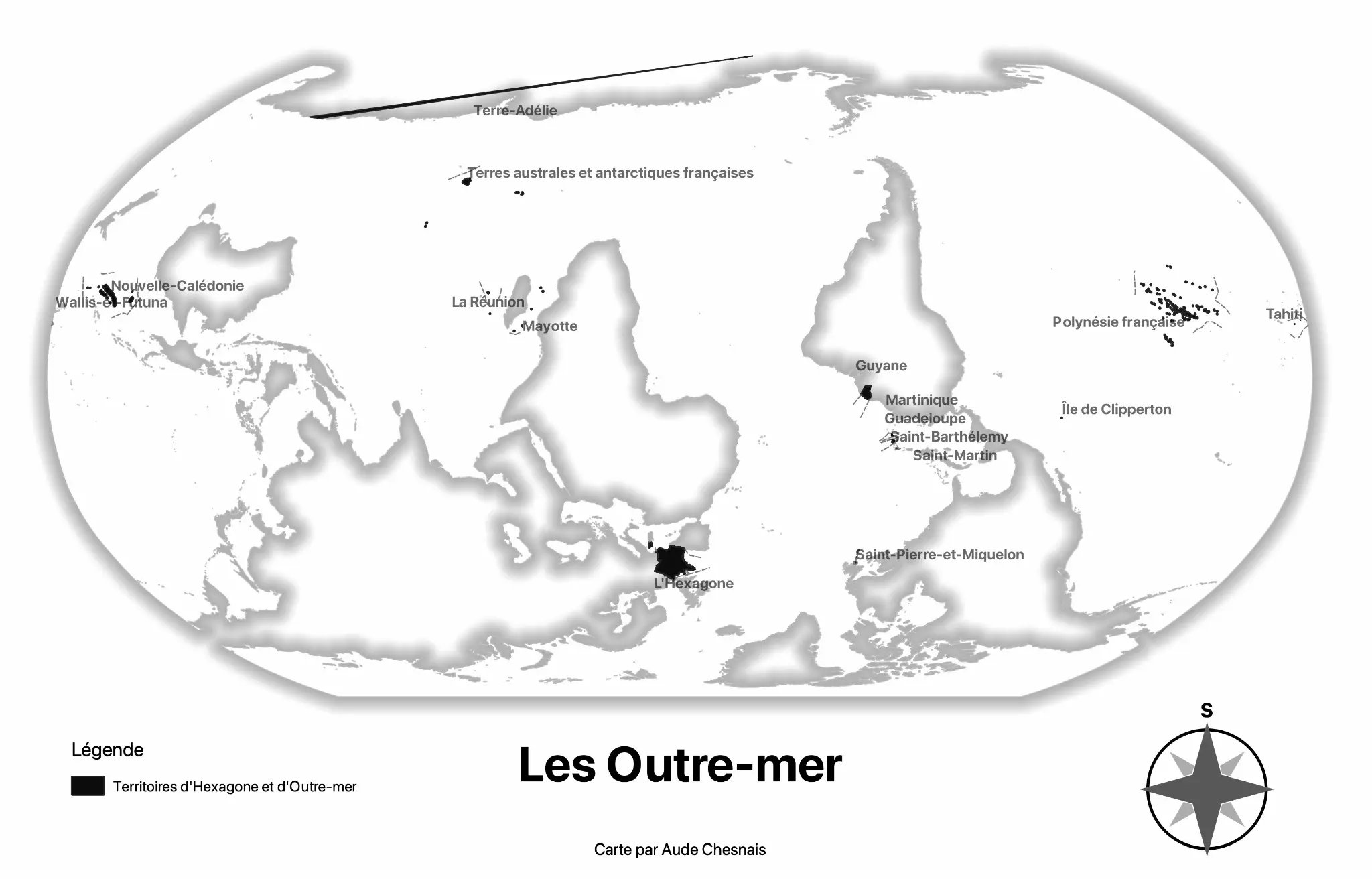
In addition to its territory on the European continent, France
comprises today 12 territories located in the Atlantic, Indian and
Pacific oceans, where some 2.6 million people live, making up 3.8%
of the country’s total population of 68 million.“Chiffres du ministère des outre-mer”, Le
ministre de l’Outre-mer, 21 July 2023,
https://www.outre-mer.gouv.fr/.
Most of these territories are small densely
populated islands no larger than 2,500 square kilometers, with the
exception of New Caledonia (18,575 sq. km.). Martinique,
Guadeloupe, Guyane (French Guiana), Saint-Barthélemy and
Saint-Martin (shared with the Netherlands) are located in the
Caribbean Sea in the Atlantic, while Saint-Pierre-et-Miquelon sits
just off the coast of Newfoundland in Canada. La Réunion and
Mayotte are in the Indian Ocean. Polynesia, New Caledonia and
Wallis-et-Futuna are French archipelagos in the Pacific. The
islands of these archipelagos are more widely scattered than those
of the Caribbean. Polynesia is made up of 118 small volcanic
islands with mountainous terrain in their center and low plains on
the coast. Other than these islands, Guyane is a territory of
86,000 sq. km. on the northeastern coast of South America.
The French Outre-mer also includes a set of uninhabited territories called the French Southern and Antarctic Lands (Terres Australes et Antarctiques Françaises, TAFF). They are for the most part occupied by scientific bases and military outposts. Four French archipelagos are found in the Indian Ocean: the Crozet archipelago, the Kerguelen Islands, the Scattered Islands (les Îles Éparses) and the islands of Saint-Paul and Amsterdam. This ensemble also includes the immense territory of Terre-Adélie (432,000 sq. km.) in Antarctica. Last among these territories is the uninhabited and very remote island of Clipperton in the Pacific Ocean. Leaving Terre-Adélie aside, these overseas territories make up 18% of the land area of France. In addition, since the adoption of the United Nations Convention on the Law of the Sea (UNCLOS) in 1982, these lands account for 97% of French maritime territory, also called the Exclusive Economic Zone (EEZ). This zone of roughly 11 million square kilometers makes France the second-ranking maritime power in the world, after the United States.
Distinct administrative statuses are attributed to these
territories under the French constitution. The four “old colonies”
of Martinique, Guadeloupe, La Réunion and Guyane, plus Mayotte,
are designated as “Départements et Régions d’Outre-Mer” (DROM)
according to the principle of legislative identity set forth in
article 73 of the constitution. This article states that “the
legislation and regulations [of France] are fully applicable by
law” in these territories, while specifying that some adaptations
are possible.Article 73 of the French Constitution (4 October
1958).
The DROM are considered to be an integral part of
the European Union (but not the Schengen Space) under the 1992
Maastricht treaty, and are counted among the EU’s Outermost
Regions, where the laws, requirements and treaties of the EU are
automatically applicable. The “Collectivités d’Outre-Mer” (COM)
include Wallis-et-Futuna, Saint-Pierre-et-Miquelon, Saint-Martin,
Saint-Barthélemy and Polynesia, and are attributed a special
legislative status that “takes into account the particular
situation and needs of each [entity] within the framework of the
Republic” as stipulated in article 74 of the constitution.Article 74 of the French Constitution (4 October
1958).
Other than certain sovereign domains of state
authority (nationality, civil rights, freedoms, justice and
security) national legislation and regulations are not
automatically in force, unless specified otherwise. These
territories are given greater legislative autonomy than the
departments, in matters such as taxation and maritime customs
duties, among others. Polynesia, for instance has its own
legislative assembly, government and president. Since the 1957
Treaty of Rome these territories have been designated as Overseas
Countries and Territories within the European Union. Although
these entities are part of EU member countries, they are not
considered to be part of the European Union. As a result, the laws
and regulations of the EU are not applicable. Nonetheless, as the
inhabitants of these countries are French citizens they are also
European citizens, and elect representatives to the European
Parliament. Consequently, EU law applies to persons in these
territories.Faberon, Jean-Yves and Ziller, Jacques,
Droits des collectivités d’outre-mer, Manuels, Paris,
2007; M’Saïdié, Thomas and Ziller, Jacques, Les pays et
territoires d’outre-mer dans l’Union européenne, Bruylant,
Bruxelles, 2013.
A long series of conflicts between the Kanak people of New Caledonia and French authorities culminated in 1988 with the abduction of hostages held in a cave in Ouvéa. In the wake of these events agreements were concluded to set up a gradual process toward independence for the territory. The accords, known as the Matignon-Oudinot Agreement (1988) and the Noumea Agreement (1998) attributed a unique status to New Caledonia, neither DROM nor COM. The governance of New Caledonia is set forth in Title XIII of the Constitution. This independence process, which stipulated three successive referendums, is now in deadlock because of fundamental differences with the French central government under President Emmanuel Macron. The central authorities required that the third referendum on independence be held in 2021, during the lock-down imposed in France due to the COVID-19 pandemic, flouting the wishes of the advocates of Kanak independence to honor the dead, and to postpone the referendum in order to allow campaigning without pandemic-related sanitary and health restrictions. This final referendum was boycotted by many, and voter participation was half that of the previous referendums. The final result, against independence, has not been accepted by the population of New Caledonia. New Caledonia is also an Overseas Country and Territory of the European Union.
The composition of the group of French overseas territories has
been in flux since 1946, and further changes are possible in the
future. Political change may come from the peoples of these
territories themselves, as seen in Polynesia, where a
pro-independence government under President Moetai Brotherson was
elected on 12 May 2023. Historically, it is due to the struggles
of local independence movements led by Jean-Marie Tjibaou and
Oscar Temaru, among others, that New Caledonia and French
Polynesia were officially (re)listed by the United Nations as
nonautonomous territories to be decolonized.“United Nations and Decolonization;
Non-Self-Governing Territories,” United Nations, https://www.un.org/dppa/decolonization/en/nsgt
(updated 4 August 2023). See Ferdinand, Malcom, “Entretien avec
Oscar Temaru et Moetai Brotherson,” in Manglou, Mélissa and
Ferdinand, Malcom (eds.), Écologie et Politique : Écologies
politiques depuis les outre-mer, vol. 63, Latresne, Le Bord
de l’eau, 2021, p.137-148.
Furthermore, French sovereignty over certain
territories is disputed. Comoros lays a claim to the island of
Mayotte, considering it to be one of the four islands of its
archipelago. Mayotte was separated from the other islands by
France when Comoros became independent in 1975. At the time this
action by France was condemned by the General Assembly of the
United Nations which declared that “the referendums imposed on the
inhabitants of the Comorian island of Mayotte constitute a
violation of the sovereignty of the Comorian State and of its
territorial integrity.” The assembly called upon the government of
France “to withdraw immediately from the Comorian island of
Mayotte, an integral part of the independent Republic of the
Comoros, and to respect its sovereignty” (21 October 1976).Resolution A/RES31/4 adopted by the General
Assembly of the United Nations on 21 October 1976 during its 31st
session, on the question of the Comorian island of Mayotte. See
Idriss, Mamaye, Le combat pour Mayotte française :
1958-1976, Paris, Khartala, 2018.
Regarding uninhabited territories, Madagascar lays
a claim to four of the five islands among the Scattered Islands
(Les Glorieuses, Europa, Juan de Nova and Bassas da India).
Mauritius claims the fifth island (Tromelin).
This brief overview of the geographical and political horizons
of France shows that, in contradiction with a colonial and
Eurocentric vision, today France is a territory of multiple
locations, spread across three oceans, and hence cannot be reduced
to its continental European entity alone. The marginalization of
the territories situated elsewhere than on the continent of Europe
is not merely the consequence of the geographic discontinuity of
these lands, with distances of several thousand kilometers between
some territories. This marginalization follows and perpetuates a
colonial split, both historical and contemporary, which
distinguishes the hexagonal territory—the former Metropole—from
the overseas lands. The population of “metropolitan” or “mainland”
France, consequence of the structural whiteness of the
construction of the nation forged by the history of the colonial
Empire, continues to be thought of and represented as primarily
White.Quijano, Aníbal, “Colonialidad del poder,
eurocentrismo y América Latina,” in Lander, Edgardo (ed.), La
colonialidad del saber: eurocentrismo y ciencias sociales,
Buenos Aires, CLACSO, 2000, p. 202; Morrison, Toni, Playing in
the dark: whiteness and the literary imagination, Cambridge,
Harvard University Press, 1999.
The overseas territories, former colonies, are home
to people in their majority thought to be and represented as
non-White. The asymmetrical nature of this configuration is
flagrantly visible when the sociopolitical status of individuals
in the socially and racially White group, with their origins in
“metropolitan” France—the so-called “Metros”—who live or visit the
overseas territories, is compared with the status of the
racialized individuals, people of color, with their origins
overseas, who live or visit the European “Metropole.” On the one
hand, we note the comfortable economic status of the Metros
overseas, their dominant position in local businesses and markets,
their access to high-level public jobs and over-representation in
government administration, in cultural institutions and scientific
research. On the other, we find discrimination in housing and
employment for people of color in metropolitan France, police
harassment on the basis of skin color, structural racism in the
courts, leading to over-representation of people of color in
prisons, to discrimination in access to positions in higher
education, and to the invisibilization of people of color in the
arts, culture and media.Léobal, Clémence, Ville noire, pays Blanc :
Habiter et lutter en Guyane française, Lyon, Presses
Universitaires de Lyon, 2022. Brunetaux, Patrick and Pulvar,
Olivier, Les Métropolitains à la Martinique : une migration de
confort, Fort-de-France, K. éditions, 2022. Zecler, Michel,
Rester debout, Paris, Plon, 2021. Beauvallet, Willy,
Célestine, Audrey and Roger, Aurélie (eds.), “L’État outre-mer. La
construction sociale et institutionnelle d’une spécificité
ultramarine,” Politix, vol. 116, n° 4, 2016,
p. 139-161. Marboeuf, Olivier, Suites décoloniales : s’enfuir
de la plantation, Rennes, Éditions du Commun, 2022. Niang,
Mame-Fatou, Identités françaises : banlieues, féminités et
universalisme, Leiden, Brill-rodopi, 2020.
Despite the equal rights of citizenship promised by
the 1946 legislation granting the status of département
to certain territories, one can only observe the great social
inequality and infrastructure deficit in the overseas lands that
persist today, perpetuating the fault lines of the colonial
period. The inhabitants of the overseas territories have become
citizens of another class.Larcher, Syliane, L’autre citoyen : l’idéal
républicain et les Antilles après l’esclavage, Paris, Points,
2022 [2014].
The very term of “overseas” is quite literally a French
colonial fabrication, and continues to be contested today.
Beginning with historical variation in the gender accorded to
“overseas”—le or la outre-mer—and
designation as a singular or plural entity—l’outre-mer or
les outre-mer—this term raises political and
epistemological issues. The political issues are tied to the fact
that it is difficult, and even violent, for some people in these
territories to hear their homeland called “beyond” the seas, far
from the center, or worse, identified by the associated adjective
“ultramarin” or “ultramarine”. The epistemological problem arises
in that by using these terms without questioning them people risk
adopting the colonial perspective they embody. There is also the
risk of obscuring other languages and other ways of naming these
lands, i.e., reference frameworks other than the historical French
colonial framework, in which people speak of Madinina, of
Karukera, Te Ao Ma and Kanaky, rather than of Martinique,
Guadeloupe, Polynesia or New Caledonia, respectively. At bottom,
nowadays only the French state and government continue to take the
term “overseas” for granted. This absence of questioning is
sometimes cloaked in a thick veil of condescension and derisive
allusion to an “exotic” other.Garde, François, Petit éloge de
l’outre-mer, Paris, Gallimard, 2018.
Nonetheless, this notion remains an administrative
category in the governance of these territories, and as such
structures certain aspects of the daily life of their inhabitants.
Even though the appropriateness of the term is disputed, I use it
here, not to accept the underlying view, but rather to reveal the
blind spots and limitations of the term, and the situations of
domination experienced by the inhabitants of these territories,
who, whether they like it or not, are confronted with global
climate change in the context of the legal and political
configuration inherited from the French colonial empire.
Low greenhouse gas emissions, high exposure
When faced with climate change, the overseas territories are
often caught in a two-pronged vise of marginalization, at the
national and international levels. At the national level, the
marginalization of the overseas in the imagination of France gives
rise to discrimination in many domains—politics, the economy,
cultural affairs, and social, legal and legislative matters. This
discrimination, whether hypocritical or careless, is prejudicial
to these territories which give France a foremost position on the
world chessboard. They support, among others, a military and
political presence in three oceans; the development of France’s
nuclear power via 193 nuclear tests carried out on the Moruroa and
Fangataufa atolls in Polynesia from 1966 to 1996 (after those
conducted in Algeria); and a strategic position in space
exploration with the Centre Spatial Guyanais (CSG) in Kourou,
which serves all of Europe. And yet, from the 1970s to today, the
overseas territories continue to be a blind spot within the
organizations, political parties and intellectual production of
the political ecology movement in metropolitan France,
particularly regarding climate issues. The overseas territories
receive relatively little attention in metropolitan climate
movements such as Youth for Climate and Alternatiba.Manglou, Mélissa, and Ferdinand, Malcom, “Penser
l’écologie politique depuis les outre-mer français” in Manglou,
Mélissa and Ferdinand, Malcom (eds.), op. cit., p.11-26.
But, while deadly heat waves recur in Europe and in
metropolitan France, the overseas territories are undoubtedly the
places in France that are the most exposed and vulnerable to the
consequences of global warming.
Internationally, most climate action and climate justice
movements have focused on the discrepancies between the
contributions of individuals or countries to global warming, and
the geographic and sociopolitical consequences incurred.Gardiner, Stephen, “Climate justice” in Dryzek,
John, Norgaard, Richard, and Schlosberg, David (eds.), The
Oxford Handbook of Climate Change and Society. Oxford: Oxford
University Press, 2011.
Small Island Developing States (SIDS) have rightly
called for distributive justice, as expressed by the powerful
voice of Mia Mottley, prime minister of Barbados.Schlosberg, David, Defining Environmental
Justice: Theories, Movements, and Nature, Oxford, Oxford
University Press. 2007, p. 79–99.
With the exception of Puerto Rico, academic
publications on climate justice in the Caribbean have looked
primarily at the small insular states, despite the fact that half
of the islands in the region are nonsovereign territories attached
to European states.Baptiste, Karen, and Rhiney, Kevon, “Climate
justice and the Caribbean,” Geoforum, vol. 73, 2016,
p. 17-80. Perry, Keston, “(Un)Just transitions and Black
dispossession: The disposability of Caribbean ‘refugees’ and the
political economy of climate justice,” Politics, vol. 43,
N°2, 2023, p.169–185. Sheller, Mimi, Island Futures: Caribbean
Survival in the Anthropocene, Durham, Duke University Press,
2020. Sealy-Huggins, Leon, ” ‘1.5°C to stay alive’: climate
change, imperialism and justice for the Caribbean,” Third
World Quarterly, vol. 38, N°11, p. 2444–2463.
Although these islands represent only 12% of the
population in the Caribbean, and 5% of Caribbean land area, they
make up 29% of its maritime territory.Data obtained from the Flanders Marine Institute
(2016). Maritime boundaries geodatabase: maritime boundaries
and exclusive economic zones (200NM), version 9. http://www.marineregions.org
and Central Intelligence Agency (CIA). (2018). The World
Factbook.
https://www.cia.gov/library/publications/the-world-factbook/geos/bb.html.
To address climate change from the standpoint of
these overseas territories, marginalized within their national
sphere and invisible on the international stage, we must look at
climate justice from a new angle, with an infranational
approach, and we must pay attention to inequalities across the
whole of the national territory as configured by its colonial
history, in this case the Hexagon of metropolitan France and its
overseas.Barrett, Sam, “Subnational climate justice?
Adaptation finance distribution and climate vulnerability,”
World Development, 58, 2014, p.130-142.
The French Overseas faces profound climate injustice. These
territories, which have contributed very little to global warming,
are over-exposed to its consequences. At the same time they suffer
from great vulnerability, constructed over the long term through
what I call “the colonial lifestyle.”Ferdinand, Malcom, Penser l’écologie depuis
le monde caribéen, Paris, Seuil, 2019, p. 51-68.
By this expression I designate a way of living on
the land and the relationships between the humans and nonhumans of
its ecosystems that have been imposed by modern colonization; a
way of life that exploits all living things and determines the
infrastructure of these territories in order to enrich a handful
of shareholders, in the headlong pursuit of capitalistic endeavors
in the service of metropolitan consumer markets. The table below
shows GHG emissions of French overseas territories (DROM and COM)
and of metropolitan France, and their respective shares in total
GHG emissions for France over the past 30 years.This data does not include emissions due to
international air and maritime travel and shipping (as agreed
under the UN Framework Convention on Climate Change). This means
that travel and shipping between metropolitan France and its
overseas territories are not counted for the purposes of emissions
reduction targets. Likewise, emissions from the COM territories
and New Caledonia are not included in the official total of French
GHG emissions. In this article they are counted.
| CO2eq/yr (metric tons) (UTCATF) | 1990 | 1995 | 2000 | 2005 | 2010 | 2015 | 2020 |
| DROM | 9.5 | 15.2 | 14.2 | 15.3 | 16.5 | 16.3 | 15.2 |
| % of total | 1.8 | 2.9 | 2.7 | 3.0 | 3.5 | 3.9 | 4.0 |
| COM+ New Caledonia | 3.3 | 3.9 | 3.0 | 4.7 | 5.1 | 6.9 | 5.8 |
| % of total | 0.6 | 0.8 | 0.6 | 0.9 | 1.1 | 1.6 | 1.5 |
| Overseas | 12.8 | 19.1 | 17.3 | 20.1 | 21.6 | 23.2 | 21.0 |
| % of total | 2.4 | 3.7 | 3.3 | 4.0 | 4.6 | 5.5 | 5.6 |
| Metro France | 512.5 | 496.8 | 511.8 | 484.7 | 449.5 | 400.7 | 355.8 |
| % of total | 97.6 | 96.3 | 96.7 | 96.0 | 95.4 | 94.5 | 94.4 |
Total for France (Metro + Overseas) |
525.3 | 515.9 | 529.0 | 504.7 | 471.1 | 423.9 | 376.8 |
Table 1: GHG emissions in France, 1990-2020 (based on CITEPA
data)My own compilation based on inventories of GHG
emissions and atmospheric pollutants, and atmospheric emissions
data from CITEPA (2022 and 2023), available at
https://www.citepa.org/fr/publications/.
The overseas territories do contribute to global warming. But the level of emissions is low compared to the rest of France. In 1990, the reference year for most international climate agreements, the French overseas territories represented only 2.4% of total emissions for France. The share of the overseas territories in French emissions has grown steadily since 1990, and now represents 5.6% of total emissions for France. As of this writing per capita emissions are higher in the overseas territories than in metropolitan France: 7.8 metric tons CO2eq/inhabitant compared to 5.5 metric tons CO2eq/inhabitant. If we look no further, one might exclaim, “See, the people in the overseas territories are those who contribute the most to climate change!” It must be remembered, however, that GHG emissions are the consequence not only of final consumption, but also of modes of land use, energy infrastructure and production facilities. By this measure, in 2020 the overseas territories account for close to one-fifth (18%) of total national land area, while their GHG emissions represent only 5.6% of total emissions.
Furthermore, while the increase in GHG emissions overseas
contrasts with the slow decrease in total emissions for France,
this increase is not so much due to different behavior on the part
of residents overseas and those living in metropolitan France, as
it is due to distinct types of energy production. Some ten years
ago a parliamentary report had already drawn attention to the
dependence of the overseas territories on fossil energy.Bareigt, Ericka and Fasquelle, Daniel,
Rapport d’information sur l’adaptation du droit de l’énergie
aux outre-mer, Paris: Assemblée Nationale, 2014.
Another parliamentary inquiry reached the same
conclusion in 2023.Rimane, Davey and Ratenon, Jean-Hugues,
Rapport d’information sur l’autonomie énergétique en
outre-mer, Paris, Assemblée Nationale, 2023.
Despite a recent trend away from fossils fuels, all
the overseas territories still depend on fossil resources such as
coal and oil for over 80% of their energy use: 83% in Guadeloupe
(2021); 82% in Martinique (2020); 98% in Mayotte (2020); 81% in
French Guiana (2020); 94% in Polynesia (2019); 86% in La Réunion
(2022); 96% in New Caledonia (2021).Figures from the following sources: Observatoire
de l’énergie — Direction de l’Industrie, des Mines et de l’Energie
de la Nouvelle-Calédonie — 2021. Belfort, Amélie, Bilan de
l’Énergie 2021, Observatoire Régionale de l’énergie et du
climat de Guadeloupe, 28 September 2022. Sylvestre-Baron, Teiki,
Bilan énergétique polynésie française : édition 2019,
Observatoire Polynésien de l’énergie and ADEME Polynésie
française, 28 February 2021. Hoarau, Mathieu, Bilan
énergétique Réunion : les chiffres clés 2022, SPL Horizon
Réunion, 2023. “Bilans énergétiques des départements d’outre-mer
de 2013 à 2020,” Données et études statistiques,
Ministère de la transition écologique, 14 April 2022.
All these fuels are imported, and the dependency on
fossil fuels is simply another facet of energy nonsovereignty.
Although environmental conditions are favorable for the
exploitation of hydraulic, solar, wind and geothermal resources,
the development of renewable energy is still lagging in these
territories. Fossil energy use is much lower in metropolitan
France, at 46% of total consumption (2021) due to the dependency
on nuclear power (40% in 2021).Andrieux, Virginie, Meillac, Christophe and
Mesqui, Bérangère (ed.), Chiffres clés de l’énergie : édition
2022, Services des Données et Études de la Statistique,
November 2022.
With under 6% of total GHG emissions for France, the overseas
territories are on the front lines when it comes to the
consequences of global warming, due to geographic factors. Most of
these territories are islands in tropical latitudes and have
already seen a significant increase in average temperature. For
example, in New Caledonia and in Martinique, and from 1970 to
2009, the average temperature increases observed are 1.3°C and
1.44°C respectively, nearly twice the average global increase for
the same period.Observatoire National sur les Effets du
Réchauffement Climatique (ONERC), Les outre-mer face au défi
du changement climatique : Rapport au premier ministre et au
parlement, Paris, La Documentation française, 2013,
p. 28.
During the same time period the sea level rose at
the pace of 3 mm per year.ONERC, op. 32.
It is estimated that the sea level in these lands
will rise by between 40 centimeters and 1 meter by the end of the
century.ONERC, op. cit., p. 34.
The landscape of these two territories are flat
plains with low slopes, and a slight vertical elevation of the sea
level is sufficient to cause a significant horizontal retreat of
the coastline, and loss of a substantial amount of land area. In
Martinique it is common to hear the elders of the towns of Vauclin
in the south or Le Prêcheur in the north say that their childhood
homes or the fields where they played soccer are now in the sea.
The consequences of global warming are not limited to the overseas
territories, and the average temperature has risen by 1°C in
metropolitan France. The island geography and small size of these
lands, however, makes loss of land area highly problematic for the
social and economic life of their inhabitants, threatening to
submerge roads, marketplaces, town squares and homes along the
coast.“Le réchauffement climatique observé à l’échelle
du globe et en France,” Météo France, 7 August 2015,
http://www.meteofrance.fr/climat-passe-et-futur/le-rechauffement-observe-a-l-echelle-du-globe-et-en-france.
Geographic factors are also important in relation to
hurricanes. While the overall frequency of hurricanes has not
increased with global warming, the presence of a larger mass of
water vapor in the atmosphere produces heavier rainfall when
hurricanes make landfall. The same relationship holds for rising
temperature and higher winds during tropical storms. We are
experiencing not more hurricanes, but more intense
hurricanes.Walsh, Kevin et al., “Tropical cyclones and
climate change,” WIREs Climate Change, vol.7, N°1,
p. 65-89. Knutson, Thomas et al., “Tropical Cyclones and Climate
Change Assessment: Part II: Projected Response to Anthropogenic
Warming,” in Bull. Amer. Meteor. Soc., vol.101, 2020,
p. E303 – E322.
The dramatic consequences of this trend have
already been seen, with the category 5 hurricanes Irma and Maria
that swept through the Caribbean in 2017, causing particularly
heavy damage in Saint-Martin and Saint-Barthélemy. The increased
intensity of hurricanes also brings a greater storm surge, the
temporary rise in sea level along the coast during hurricanes,
such as the surge that caused destructive flooding in New York
City in October 2012.Ayyad, Mahmoud, Hajj, Muhammed, and Marsooli,
Resa, “Climate change impact on hurricane storm surge hazards in
New York/New Jersey Coastlines using machine-learning,” in npj
Climate and Atmospheric Science, vol.6, N°88, 2023.
Rising sea levels and receding coastlines also have major
political consequences for the peoples of the Pacific. The Fiji
writer Epeli Hau’ofa reminds us that for the many peoples of the
Pacific they inhabit an ocean sprinkled with islands, and not
islands surrounded by ocean.Hau’ofa, Epeli, Notre mer d’îles,
(translated by. G. Colombani, T. Isselé and S. Massau), Arue,
Pacific Islanders Éditions, 2013.
Receding coastlines can also lead to loss of
maritime space. The maritime domain of countries is determined by
measurements drawn from the coastline, and a receding coastline
will shrink the maritime domain that is so important for these
peoples. For this reason, among others, the Taputapuatea
Declaration of the peoples of Polynesia denouncing the dangers of
climate change (July 2015) calls for the lines of maritime domains
to be permanently set, to ensure the future maritime activity of
these territories in the face of climate change.Lallemant-Moe, Hervé Raimana, “Les défis
territoriaux et spatiaux des changements climatiques pour les
territoires du Pacifique,” in Manglou, Mélissa and Ferdinand,
Malcom (eds.), op. cit., p.125-131.
These territories are highly exposed to the impacts of global
warming, and their ecological systems are highly vulnerable. The
endemic ecosystems of these territories are located in critical
zones for biodiversity, augmenting the risks associated with
climate change. On the scale of France as a whole, the overseas
territories are home to some 80% of the fauna and flora that
constitute natural biodiversity.Gargominy, Olivier, and Boquet, Aurélie,
Biodiversité d’outre-mer. Paris, Comité Français, UICN,
2013. The measurement and metrics of biodiversity are much more
complex than simple percentages, and merit discussion in a
separate article. The figures given here are not meant to slight
the importance of France’s European ecosystems, but to underscore
the richness of ecosystems in the so-called overseas
territories.
The biodiversity of France is found in the
extensive Amazon forest of Guyane and in the mangroves of
Martinique, Guadeloupe and Mayotte. The largest contiguous forest
of the European Union is in Guyane. Guyane is six times smaller
than metropolitan France and is home to three times as many
vertebrate species.ONERC, Les outre-mer face au défi du
changement climatique : Rapport au premier ministre et au
parlement, Paris, La Documentation française, 2013,
p. 49.
The endemic biodiversity of France is for 97% found
in the overseas territories. Biodiversity is also preserved in
marine locations. The 11 million square kilometers of France’s
overseas marine domain are home to 10% of the coral reefs and 20%
of the atoll habitats on Earth.Initiative française pour les Récifs CORalliens
(IFRECOR), “Récifs coralliens les joyaux de l’outre-mer,”
Ifrecor, 3 Juy 2011,
http://www.ifrecor.com/recifs-coralliens.html.
The warming of sea water and acidification of the
oceans endanger these delicate ecosystems.
Vulnerability induced by the colonial lifestyle
Far from being a natural phenomenon, the vulnerability of these
territories in the face of climate change is the result of the
historical, socioeconomic, geographic and political construction
of the colonial lifestyle.Ferdinand, Malcom, Une écologie
décoloniale, p. 51-68.
Since the beginnings of the historical and colonial
edifice, the territories’ economic structures have registered the
most alarming social indicators in France, for instance the
unemployment rate, which is two to three times higher than in
metropolitan France. When unemployment reached 7.1% in
metropolitan France in 2022, the rate stood at 13% in Martinique
and Guyane, 11% in New Caledonia, 18% in Guadeloupe and La
Réunion, and 34% in Mayotte.“Taux de chômage localisés par sexe et âge en
moyenne annuelle en 2022 Comparaisons régionales et
départementales,” INSEE, 25 May 2023, https://www.insee.fr/fr/statistiques/2134411#tableau-TCRD_087_tab1_regions2016 .
Jonzo, Anne, “2000 emplois de moins qu’avant la crise sanitaire et
forte hausse du chômage Enquête Emploi 2022 à Mayotte,” INSEE,
9 February 2023, https://www.insee.fr/fr/statistiques/6798031 .
Dukunengo, Annette, “Synthèse, Enquête force de travail 2022,”
Institut de la Statistique et études économiques
Nouvelle-Calédonie (ISEE), août 2023,
https://www.isee.nc/emploi-revenus/emploi-conditions-de-travail/emploi-chomage.
Only Polynesia has a comparable rate of
unemployment, at 9% in 2022.“L’emploi progresse en 2022, le nombre d’inactifs
ne souhaitant pas travailler également,”, Institut de la
Statistique Polynésienne (ISPF), 30 December 2022,
https://www.ispf.pf/publication/1359.
In 2018 39% of the residents of Mayotte and 77% of
the people in La Réunion lived below the poverty level.Grangé, Claire, “Le taux de pauvreté reste stable
en 2018 à La Réunion,” INSEE Flash Réunion, 28 January
2021, www.insee.fr/fr/statistiques/5016838.
Furthermore, the calculation methods used by the
INSEE statistics bureau tend to under-estimate the problem.Patent, George, “Sincérité des taux de pauvreté
en outre-mer,” Sénat : questions écrites, 28 February
2019,
https://www.senat.fr/questions/base/2019/qSEQ190209202.html.
The cost of living is quite a bit higher overseas
than in metropolitan France. A study in 2020 found that a typical
food basket cost between 39% and 46% more overseas than in
metropolitan France.Méjean, Caroline et al. (ed.), Alimentation
et nutrition dans les départements et régions d’outre-mer,
IRD Éditions, Marseille, 2020, p. 106.
In addition there are numerous shortcomings in the
organization of public services that in effect block access to
certain social benefits, as was noted by France’s public rights
advocate in 2023.Rapport: Service public aux Antilles :
garantir l’accès aux droits, Paris, Défenseur des droits,
2023.
The persistent inequality between the overseas
territories and metropolitan France was one of the grievances
behind the general strikes in Guadeloupe, Martinique and La
Réunion in 2009, in Mayotte and New Caledonia in 2016, and in
Guyane in 2017.William, Jean-Claude, Reno, Fred, and Alvarez,
Fabienne (eds.), Mobilisations sociales aux Antilles : les
événements de 2009 dans tous leurs sens. Paris: Karthala,
2012. Odin, Pierre, Pwofitasyon : luttes syndicales et
anticolonialisme en Guadeloupe et en Martinique, Paris, La
Découverte, 2019.
The 2017 legislation to promote equal treatment for
the overseas territories notwithstanding, inequality continues to
be marked.Loi n° 2017-256 du 28 février 2017 de
programmation relative à l’égalité réelle outre-mer et portant
autres dispositions en matière sociale et économique.
The quest for “real equality,” sustaining the
decolonization process, remains a core issue in civil society.
The colonial lifestyle maintains local economies that are
structurally founded on nonsovereignty in terms of food supply for
the inhabitants of overseas territories. The absurdity of the
colonial lifestyle with respect to climate change is most glaring
in the cultivation of bananas in the Antilles islands. Banana
plantations suffer heavy damage with each hurricane of even modest
intensity. This sector of agriculture depends on the resistance of
these giant herbaceous plants that are battered by winds of over
200 km/hour, year after year. Likewise, the Global Footprint
Network estimates that the island of La Réunion, with an economy
based on sugar exports, exceeds its annual biocapacity (the
capacity of ecosystems to replace the resources withdrawn by human
activity) by some 3,200% each year, making this island the
territory with the third largest ecological deficit in the
world.Footprint Data Foundation, York University
Ecological Footprint Initiative, and Global Footprint Network:
National Footprint and Biocapacity Accounts, 2023 edition,
data.footprintnetwork.org/#/.
Martinique and Guadeloupe rank respectively
18th and 21st in terms of ecological
deficit, exceeding their biocapacity by 680% and 590%
respectively. The Antilles islands and La Réunion export thousands
of metric tons of bananas and sugar, but are not able to feed
their inhabitants or ensure the biological renewal of their
ecosystems. The colonial lifestyle also stands out for its
nonsovereignty in terms of energy use—these territories depend on
fossil fuels for over 90% of their consumption.Bareigts, Ericka and Fasquelle, Daniel, op.
cit., p. 9.
This means that when hurricanes or other events
prevent oil tankers from reaching the islands, their
infrastructure is plunged into complete paralysis. As seen on
Saint-Martin after the passage of hurricane Irma, the fragility of
water supply infrastructure, nonsovereignty in food and energy
supply, compounded by precarious economic circumstances and
poverty, are the ingredients of a catastrophe waiting to happen
with the occurrence of any severe or intense environmental
event.Pastel, Audrey and Saffache, Pascal, “Le plan de
prévention des risques naturels (PPRN) : frein ou catalyseur de
l’adaptation des territoires insulaires au changement climatique ?
Exemple de Saint-Martin suite à l’ouragan Irma,” Études
caribéennes, vol.48, April 2021.
Lastly, these territories are exposed to multiple environmental
risks in addition to the consequences of global warming. The
emergence of an underwater volcano off the island of Mayotte has
caused the island to subside, in conjunction with rising sea
levels due to global warming. Martinique and Guadeloupe are also
volcanic islands, located in a subduction zone with regular
seismic activity. The two islands have been durably marked by the
chlordecone contamination scandal. This insecticide compound,
officially in use from 1972 to 1993 in banana plantations, has
caused long-term generalized harmful contamination of ecosystems
in the Antilles and damage to human health and habitat.Malcom, Ferdinand, “Toxic Time-scape & the
Double Fracture of Modernity: Chlordecone Contamination of
Martinique and Guadeloupe,” in Muller, Simone and Nielsen,
May-Brith (eds.), Toxic Timescapes Examining Toxicity across
Time and Space, Ohio University Press, 2023 p. 253–284.
The heavy rains of tropical storms and hurricanes
often damage water ducts, allowing chlordecone to infiltrate into
water supply systems and contaminate drinking water.Feuillet, Nathalie et al., “Birth of a large
volcanic edifice offshore Mayotte via lithosphere-scale dyke
intrusion,” Nature Geoscience, vol.14, 2021,
p.787-795.
Can the overseas territories speak up in the face of climate change?
In the words of Gayatri Spivak with reference to the subaltern,
do the inhabitants of overseas territories have the political
option of speaking up in the face of climate change?Gayatri, Spivak, “Can the subaltern speak?” in
Nelson, Carry and Grossberg, Lawrence (eds.), Marxism and the
Interprétation of Culture, Champaign, University of Illinois
Press, 1988, p. 271-31.
Are they considered to be political subjects in
their own right, endowed with speech, capable of expressing their
own cosmologies and conceptualizations of climate issues and their
right to participate in national and international debates? Along
with their high exposure to the consequences of global warming and
their ecological and sociopolitical vulnerability, the French
overseas territories are also politically ostracized within the
Republic of France. First, in electoral terms the 2.6 million
inhabitants of these lands have but little weight in French
national politics. More fundamentally, the notion that French
overseas citizens might speak out on national topics other than
their own social and political issues (and even that is not sure)
is met with surprise, or is not readily accepted, in the minds of
the residents of metropolitan France. Inversely, it is taken for
granted that the inhabitants, representatives and elected
officials of metropolitan France have every right to hold forth on
the situation in the overseas territories. This political and
symbolic asymmetry is one of the ongoing aspects of the colonial
relationship between the Metropole and the Overseas. It is an
underlying principle of the Ministry of the Colonies, renamed
Minister of Overseas Territories in 1946, a government office that
continues to be physically located in metropolitan France. This
asymmetrical relationship is also at work in the appointment of
ministers and deputy ministers who have no ties with the overseas
territories, as is the case with the ministers serving under
President Macron since 2022.
In epistemic terms, this structural, political and symbolic
ostracism is perpetuated in the theoretical understanding of the
stakes of global ecology issues, as they are understood from the
vantage point of metropolitan France, by the activists and
militants of French political ecology movements, environmental
movements and in national environmental policy and politics. The
history of the intellectual production of political ecology
movements and of environmental philosophy in France is notable for
its silence on colonial issues and its exclusion of the voices of
overseas scholars. In addition to relegating these voices out of
hearing, out of sight and mind, this latent epistemic racism
induces the failure to recognize other ways of approaching,
thinking about, analyzing, writing about and narrating climate
change.Fricker, Miranda, Epistemic Injustice: Power
and the Ethics of Knowing, Oxford, Oxford University Press,
2007. Grosfoguel, Ramon, “The structure of knowledge in
westernized universities: Epistemic racism/sexism and the four
genocides/epistemicides of the long 16th century,” Human
Architecture: Journal of the Sociology of Self-Knowledge,
vol. 11, N°1, 2013, p. 73–90.
The singular status of the overseas “collectivités” (COM) in the French Republic and the ambivalent nature of their attachment to the European Union replicates these forms of exclusion, at the national and international levels. On the international stage the overseas entities are not entitled to their own voice in the climate change debate. Despite their ecological significance the overseas territories do not have their own voice at the UNFCCC. Unlike their neighbors—Fiji, Vanuatu and Tuvalu in the Pacific, Comoros and Mauritius in the Indian Ocean, Sainte-Lucie, Dominica, Surinam and Haiti in the Caribbean, the French overseas territories are neither parties to the convention nor recognized as observers. Officially they are represented by France.
When France signed and ratified the UNFCCC accords in 1992 and 1994 its agreement included all emissions of its overseas territories. In other words, France must inform the other parties to the convention of its progress in GHG reductions for all its territories, including the overseas “collectivités.” At the same time, France’s signature of the Kyoto Protocol was given as a member of the European Union. Thus, as the COM entities are not included within the European Union, the agreements and provisions of the Kyoto Protocol do not apply to the overseas “collectivités” or to New Caledonia, but do apply to the overseas departments. This means that the reference figure for GHG emissions in 1990—the level from which France must reduce its emissions—does not account for and does not include emissions from Saint-Pierre-et-Miquelon, Mayotte, French Polynesia, Wallis-et-Futuna or New Caledonia. These territories are excluded from the Kyoto Protocol and its associated programs regarding emissions. As was the case at COP 21, the COM entities and New Caledonia must individually agree to respect the agreements, but their commitment is formulated as part of their affiliation with France, and not on the international level.
This exclusion from the international scene has consequences for access to certain sources of international funding such as the Green Climate Fund intended for Small Island Developing States (SIDS). This fund was created in 2010 under the UNFCCC to finance projects in developing countries, in small insular states and in African countries facing the consequences of climate change. Unlike independent states, the French overseas territories do not have access to this funding.
Caught in a political limbo, the overseas territories, like
other nonstate entities, try to influence international
decision-making on climate change by participating in side events
at COP meetings and in informal forums.Schroeder, Helke, and Lovell, Heather, “The role
of non-nation-state actors and side events in the international
climate negotiations,” Climate Policy, vol.12, N°1, 2012,
p. 23–37. Nasiritousi, Naghmegh, Hjerpe, Mattias, and Linnér,
Björn-Ola, “The roles of non-state actors in climate change
governance: understanding agency through governance profiles,”
International Environmental Agreements: Politics, Law and
Economics, vol. 16, N°1, 2016, p. 109–126.
They follow two principal strategies. The first is
to use their national and EU affiliation to press for financial
resources to confront and adapt to climate change. To this end in
2015 three members of the French Parliament representing overseas
territories submitted a report to the National Assembly prior to
the COP 21 meeting. The authors, Serge Letchimy from Martinique,
Ibrahim Aboubaca from Mayotte and Maïna Sage from Polynesia,
described the particular status of these French territories that
suffer the same consequences of climate change as neighboring
countries, but do not have access to the same types of funding to
address the issue.
“Climate change knows no borders! Our Nation is to be praised for its commitment in favor of the most deprived and vulnerable of independent States, and thus it is inconceivable that the overseas territories of France should be deprived of the same support, considering both the extreme environmental and economic vulnerability of these territories, and the exceptional benefits derived from their terrestrial and marine biodiversity! These lands, which have served the space missions and military forces of France, are a major geostrategic asset that deserve the full attention of our Country.”Sage, Maina, Aboubacar, Ibrahim, and Letchimy, Serge, Rapport d’information sur les conséquences du changement climatique dans les outre-mer, Paris, Assemblée Nationale, 2015, p. 54.
The overseas territories have attempted to obtain the necessary
funding on the basis of their position as French territories. A
Green Fund set up in 2023 to channel 2 billion euros to local
authorities in France is also open to the overseas territories.
Among the first 150 projects selected for funding, 18 involve
overseas territories, for a total of 8.5 million euros
(Guadeloupe, Martinique, La Réunion, Guyane, Mayotte and
Saint-Pierre-et-Miquelon).“Découvrez les premiers lauréats du fond vert
dans vos régions,” Ministère de la transition écologique, 4 April
2023,
https://www.ecologie.gouv.fr/decouvrez-premiers-laureats-du-fonds-vert-dans-vos-regions.
Other initiatives have been taken at the European level. The
Association of Overseas Countries and Territories of the European
Union has formed a working group on the environment to further
dialogue on climate change between the overseas countries and
territories and the European Commission. At the initiative of the
French committee of the International Union for the Conservation
of Nature (IUCN), a dedicated program for overseas entities called
Biodiversity and Ecosystems Services in EU Overseas Countries
and Territories (BEST) was launched in 2011 and funded by the
European Union. While several local projects have been completed
under this program, the necessary work of conservation requires
greater financial resources. The French Economic, Social and
Environmental Council, whose members are drawn from civil society,
and which is the third representative body in France, after the
National Assembly and the Senate, came to the same conclusion in a
report on climate justice in 2016. Among its proposals the council
calls for the creation of a dedicated climate justice fund for all
the overseas territories, and adoption of specific targeted
solutions when possible.Jouzel, Jean, and Michelot, Agnès, La justice
climatique : enjeux et perspectives pour la France, Paris,
Conseil Économique, Social et Environnemental and Les Éditions des
journaux officiels, 2016, p. 7-8.
The second strategy of the overseas territories is to build and participate in alliances and regional coalitions with other independent countries to gain access to international forums. Since 2006 New Caledonia and Polynesia have participated in the Pacific Islands Forum. Martinique is a full-fledged member of the Organisation of Eastern Caribbean States (OECS) and of the Caribbean Community (CARICOM). La Réunion and Mayotte have joined the Indian Ocean Commission (IOC). The Pacific Islands Forum, CARICOM and IOC have observer status at the UNFCCC Conferences of the Parties.
The low proportion of overseas emissions in total emissions for
France, the high exposure of overseas territories to the
consequences of global warming, and their poor representation in
international decision-making bodies and instances that oversee
environmental protection are the motives of this call for
infranational climate justice. Referring to the 27 principles set
out in the Bali Principles of Climate Justice in 2002, I would
like to draw attention to three fundamental aspects of true
climate justice for the overseas territories.International Climate Justice Network, “Bali
Principles of Climate Justice,” Corpwatch, 28 August
2002,
https://www.corpwatch.org/article/bali-principles-climate-justice.
Principles 3, 19, 20 and 21 “affirm the rights of indigenous peoples and affected communities to represent and speak for themselves” and “to participate effectively at every level of decision-making.” The principles “demand that public policies be based on mutual respect and justice for all peoples, free from any form of discrimination or bias” and recognize “the right to self-determination of Indigenous Peoples and their right to control their lands, including sub-surface land” and “the right to say ‘No’” to any action that threatens their territory, culture or way of life. At present the French overseas territories are not adequately or specifically represented with respect to the issues of climate change, whether in scientific forums or political institutions. These territories’ right to sovereignty over their lands remains contingent on the goodwill of central government in Paris. To ensure climate justice the power and right of decision-making must be recognized for communities and their land and marine spaces, in each of the overseas territories.
Secondly, principle 7 of the Bali Principles calls for recognition of “a principle of ecological debt” owed by industrialized countries and transnational corporations to the rest of the world for their appropriation of the planet’s capacity to absorb greenhouse gases. In this regard climate justice for the overseas territories would entail that France recognize the ecological debt incurred with these formerly colonized territories and with its former colonies that are now independent. In the course of France’s long colonial history these lands have been subject to incessant and extractivist exploitation of their soils and subsurface resources, biodiversity, ecosystems, and human and nonhuman living beings.
Thirdly, principles 11 and 22 of climate justice call for the development of renewable energy alternatives to fossil fuels, and for the recognition of women’s rights in the overseas territories. Climate justice in these territories rests upon a radical change in energy policy and for specific measures in favor of women’s rights. These three points are in my view essential to reaffirm the sacred nature of Mother Earth and to safeguard the rights of future generations.
Climate justice or decolonizing climate change?
The quest for infranational climate justice in overseas
territories comes with some problems of its own. The singular form
of decolonization without sovereignty and the assimilationist
model of département status granted after 1946 for the
purposes of full integration into the country’s administrative
structure imposes loss of memory and total silence regarding the
history of slavery and the colonial relationship.Cottias, Myriam, “L’oubli du passé contre
la”citoyenneté”: troc et ressentiment à la Martinique
(1848-1946),” in Daniel, Justin and Constant, Fred (eds.),
Cinquante ans de départementalisation, Paris, Harmattan,
1997, p. 293-313.
Does the cause of climate justice for overseas
territories necessarily rest on an implicit validation of the
political relationship between these territories and metropolitan
France? Are the demands underlying the call for climate justice
tantamount to acceptance of the postcolonial relationship? Do they
mean all criticism of this relationship must be muted? Are we
obliged to “love France” in order to insist upon justice in the
face of climate change?Diallo, Rokhaya, La France tu l’aimes ou tu
la fermes ?, Paris, Textuel, 2019.
Do the overseas territories and their
representatives have no political perspective or alternative here
on Earth other than to forever intone the mantra of their
vulnerability and dependence on metropolitan France? Must they
renounce any desire for sovereignty?Reno, Fred, “Dependancy as strategy,” in Henke,
Holger and Reno, Fred (eds.), New Political Culture in the
Caribbean, Kingston, The University of West Indies Press,
2022, p. 17–37. Constant, Fred, Géopolitique des outre-mer :
entre déclassement et (re) valorisation, Paris, Le Cavalier
Bleu, 2022, p.187-196. Bonilla, Yarimar, Non-Sovereign
Futures: French Caribbean Politics in the Wake of
Disenchantment, Chicago, Chicago University Press,
2015.
The doubt induced by the idea that the claim of
climate justice for the overseas territories implies acceptance of
the top-down narrative of metropolitan France and its domination
of the overseas lands is compounded by a general notion that the
environmental history of the world and the colonial roots of the
modern world are two separate stories. In this perspective climate
justice is caught in a double bind, which I call the “double
environmental and colonial division of modernity.”Ferdinand, Malcom, Une écologie
décoloniale, op. cit., p.11-49.
This separation makes it possible to continue to
address the three aspects of infranational climate justice for
overseas territories in a purely technical manner. Accordingly, it
is important to distinguish between the demand for climate justice
and the demand for decolonization of climate change.
In an environmentalist or technicist perspective climate change is nothing other than the physiochemical process driven by rising GHG emissions, which are increasing unequally around the globe; it is not connected to historical and contemporary unequal conditions around the world. The “political” responses to climate change are similarly technicist in conception, measured in emissions reductions calibrated in parts per million, in degrees of temperature, and not in terms of the nature of relations between human and nonhuman living beings in the Earth’s ecosystems. This is the language used in the COP accords, reducing the political problem of global warming to an economic policy for the distribution of emissions quotas authorizing the holders to continue to release emissions. Paradoxically, even the slogans of climate movements like “Save the climate!” are underpinned by a de-politicized understanding that projects the climate as the main actor on the political stage. In this conception climate justice is reduced to the arithmetic of emissions weighted by territory, obscuring the political principle of justice. These emissions equations and slogans have no political content in relation to feminist, anticapitalist or anticolonial analyses, nor do they describe the socio-environmental relationships that link human beings among themselves and with nonhuman beings. In other words, the injunctions to “save the climate” or to more equitably distribute GHG emissions contain no political proposal based on a vision of the future world. This means that climate justice can continue to be framed in terms that would in no way change the world—the domination of a group of countries (always the same ones) over others.
In this technicist perspective the colonial reflex shows
through in recurring comments such as: “Fortunately, to deal with
climate change the overseas territories are French,” or “What
would they do without France?” This reaffirms the posture of the
entity “France,” which after having plundered the ecosystems of
these lands and committed numerous colonial crimes against their
inhabitants, men and women, takes the stance of a great liberator,
and continues to treat the people of the overseas lands as
deficient beings, whose defining trait is to be saved by the white
and innocent hand of France.Célestine, Audrey, La fabrique des
identités : l’encadrement politique des minorités caribéennes à
Paris et New York, Paris, Khartala, 2018. Verges, Françoise,
Le ventre des femmes : capitalisme, racialisation
féminisme, Paris, Albin Michel, 2017. Paris, Myriam, Nous
qui versons la vie goute à goute : féminisme, économie
reproductive et pouvoir colonial à la Réunion, Paris,
Dialloz, 2020. Sptiz, Chantal, L’île des rêves écrasés,
Papeete, Les Éditions de la Plage, 1991. Césaire, Aimé,
Discours sur le colonialisme, Paris, Présence africaine,
2004 [1950].
Where the overseas territories are concerned, the
aid furnished in the wake of severe climate events such as
hurricanes is not seen as international cooperation or the
solidarity habitually manifested between countries in the event of
natural disasters, large-scale wildfires for instance. On the
contrary, this aid can turn into a reiterated argument to justify
the continuing colonial relationship with the overseas territories
and the representation of their inhabitants as only semi-French
underlings who live in the nether parts of France.
The unspoken colonial attitude and the unease it generates show
the limits of classical approaches to climate justice. These fault
lines demonstrate the necessity not only to achieve climate
justice, but, even more urgently, to decolonize climate change.
“Decolonizing climate change” means first recognizing the
colonialism underlying the unequal contributions of human
activities around the world to climate warming, and the
inequitable distribution of the consequences. It means recognizing
the inequitable nature of the place, voice and possibility of
action accorded to different protagonists nationally and
internationally. The call for decolonized thinking about climate
change is a call to join together economic and political measures
for emissions reductions and for building adaptation capacity. It
is a call to reconfigure the politics of the world and to leave
behind the period of modern colonization, and to establish
relations between the former colonizers and colonized peoples,
between their social groups, between the global North and the
global South, founded on principles of equality, justice and
dignity. This decolonial movement was first outlined in the
statement of environmental justice principles adopted at the
People of Color Environmental Justice Leadership Summit held in
Washington D.C. in 1991, and which served as a template for the
Bali Climate Justice Principles.“Principles of Environmental Justice,” Washington
DC, 1991, https://www.ejnet.org/ej/principles.pdf.
This claim, by its essence, reaches beyond national
borders.
Pending possible changes in the composition of the overseas territories, decolonization of climate change in the context of France implies a double epistemic and political shift so that another world can emerge from the history of colonization and slavery. Two preliminary remarks are called for here. Firstly, decolonization of thinking about climate change in France is not an appeal of the so-called “overseas-ers” of France to be interpreted as a request for assistance or an appeal to charity. This interpretation would create the impression that once again this aid or assistance would be of secondary importance in French climate policy, or could perhaps be dispensed with entirely. Decolonized thinking about climate change is fundamental to address the social and economic circumstances of the overseas territories, in the same way that metropolitan France must address unequal conditions across its own mainland territory, the divergence between urban areas and rural regions, the discrimination against women, poor people and people of color in low-income neighborhoods and towns. Decolonized climate change is a requisite condition for the development of French climate policy that can address the stakes of global climate change. Secondly, the practice of tokenism must be banished. It will no longer suffice to place a handful of people of color in institutional positions to project a positive image, while preserving intact the historical structure. For example, although it is symbolically important to have a person of color and resident of an overseas territory as minister for said territories, such an appointment in no way alters the structure of postcolonial relations between metropolitan France and its overseas territories.
Decolonization of thinking about climate change from the
vantage point of France involves a radical and double epistemic
shift, in the comprehension of climate change and in the
perception of the French territory from which and for which its
policy is developed. The first epistemic shift is to reshape the
conception of the French national territory. Far from being a
monolithic hexagonal chunk of Europe, France is country of
multiple lands spread across three oceans. Without recognizing the
place, voice and dignity of the overseas inhabitants, we only
perpetuate the hypocritical premises of colonial thinking that
situate the territory within the confines of the mainland, and
praise and uphold the wonderful biodiversity of the overseas lands
as well-deserved trophies. Recognition of the dignity of these men
and women can only come with a strong political and legal
engagement in light of the colonial history and enslavement at the
origin of the relations and situations as they exist today. This
recognition must rest on rest on “the principle of equal rights
and self-determination of peoples” set forth in Article 1 of the
United Nations Charter, and hence on the possibility accorded to
overseas territories to modify their status, if they wish, and to
accede to full independence and sovereignty. Recognition that
France is state of multiple locations, built upon a colonial
empire of slavery and enslavement, is key to understanding the
geographic situation of France around the world and the ways in
which the country inhabits and lives on Earth, in its terrestrial
dimensions. The question of coming “Down to Earth” is the title of
a well-known work by the late Bruno Latour, philosopher of
science; this line of questioning will always be biased if we
ignore the colonial history which is the point of departure of our
world.Latour, Bruno, Où atterrir : comment
s’orienter en politique, Paris, La Découverte, 2017.
Translated as Down to Earth: Politics in the New Climatic
Regime, Polity Press, Cambridge/Oxford (UK) 2018.
We cannot become terrestrial beings or come “down
to earth” without first establishing a different relationship with
the territories which were subjected to violence that allowed
metropolitan France to keep some of its lands.
The second epistemic shift involves remodeling the political
relationship between the mainland and the overseas lands to take
into account the ecological importance of the latter, and to
recognize the overseas inhabitants as political subjects in their
own right at the regional, national and international levels. The
call for a new political relationship was expressed in the
Fort-de-France Declaration issued by the conference of the
presidents of the French regions Martinique, Guadeloupe,
Saint-Martin, Guyane, La Réunion and Mayotte. These elected
officials underscored the “urgent need to enter into a new stage
of history” for the overseas territories and called for “reshaping
the relations between our territories and the French Republic as a
whole, under a newly defined framework for the implementation of
public policies that are aligned with the actual conditions in
each of the territories.”“Appel de Fort-de-France,” France Info,
18 May 2022,
https://la1ere.francetvinfo.fr/appel-de-fort-de-france-des-elus-d-outre-mer-appellent-l-etat-a-changer-sa-politique-d-aide-1284920.html.
Along with the economic redistribution necessary to improve living conditions and respect the fundamental right of overseas inhabitants to basic services such as access to water and better healthcare infrastructure, a political relationship must be invented to reflect the ecological importance of these territories. Considering that the 2.6 million overseas residents have the prime responsibility for 80% of the ecosystem biodiversity of France, a form of political representation—environmental democracy or even climate democracy—must devised that is commensurate with this ecological resource, if climate change is to be effectively addressed. Many forms of renewed representation are possible: creation of a parliament of environmental and ecological matters with a time frame longer than that of today’s institutions; localization of the environment and ecological transition ministry in Guyane; new parliamentary seats created for representation devoted to environmental and ecological issues; greater legislative autonomy for overseas territories; representation of overseas territories in COP meetings.
Scientific production and access to research must also be
rethought and redistributed under a remodeled relationship. For
too long the overseas territories have been the spaces and objects
of colonial and scientific extractivism, in which scientific
research has been carried out neither by nor for the
inhabitants.Smith Tuhiwai, Linda, Decolonizing
Methodologies: Research and Indigenous Peoples, third
edition, Bloomsbury, London, 2022.
Once again, in light of the ecological significance
of these territories and their exposure to climate risks, these
territories and above all their inhabitants have
fully legitimate grounds to develop within their territories
advanced scientific facilities in all disciplines to lead research
on environmental and ecological issues. A foundational starting
point would be to provide local residents with automatic funding
for Master’s degree studies and doctoral theses in areas of
ecological importance, targeting students from those territories
that have suffered from ecocide—massive and potentially
irremediable destruction of ecosystems—as the result of nuclear
weapons testing, mining in New Caledonia and Guyane, pesticide
pollution in Martinique, Guadeloupe and La Réunion. This would be
a step to leave behind the colonialism that continues to underlie
the science of climate change and the status of overseas
territories. In addition to funding, the type of research and
scientific work needed must be rethought, to build research on the
principle of epistemic justice that recognizes the various sources
and forms of production of knowledge.Médina, José, The epistemology of
resistance, Oxford, Oxford University Press, 2012. De Sousa
Santos, Boaventura, Epistemologies of the South: justice
against epistemicide, London, Routledge, 2016. Solbiac,
Rodolphe, La destruction des statues de Victor Schoelcher en
Martinique : l’exigence de réparation et d’une nouvelle politique
des savoirs, Paris, L’Harmattan, 2020, p.109-113.
Revamped research institutions would recognize the
fundamental political and epistemic role that nonprofit groups and
collectives have played in these territories for over 40 years, in
the defense of ecosystems and the conceptualization of ecological
issues. Examples are Zéro poison–zéro chlordecone and
Assaupamar in Martinique, Vivre and
Envie-Santé in Guadeloupe, 193 in Polynesia,
Ensemble pour la Planète in New Caledonia,
Sillages in La Réunion and La Jeunesse autochtone de
Guyane in Guyane.Cabanes, Valérie, Un nouveau droit pour la
Terre, Paris, Point, 2021 [2016].
Lastly, to decolonize thinking on climate change from the
vantage point of France also means developing these measures in
the broader framework of justice and reparations for the crimes of
slavery and colonization. The African American philosopher
Olúfémie Táíwò has shown that a policy of reparations for slavery
and colonization cannot be implemented without some form of
climate justice.Táíwò, Olúfẹ́mi, Reconsidering reparations:
worldmaking in the case of the climate crisis, New York,
Oxford University Press, 2022.
The other side of the coin is just as important.
Following through on earlier proposals, I think climate justice
cannot be envisioned without reparations for the historic crimes
of colonization and slavery.Ferdinand, Malcom, une écologie
décoloniale, op. cit., p. 390-400.
Before they came to be presented as areas of
ecological importance for France, these spaces were sacrificial
zones for France, where ceaseless exploitation of human and
nonhuman beings knew no limits.Lopes de Souza, Marcelo, ” ‘Sacrifice zone’: The
environment-territory-place of disposable lives,“Community
Development Journal, vol. 56, N°2, April 2021,
p. 220–243.
Let us remember that the last round of nuclear
weapons testing in France was conducted in 1996, four years after
France had signed the UN Framework Convention on Climate
Change.See le nonprofit “193” : https://www.oneheart.fr/assos/association-193-1014 .
Philippe, Sébastien and Statitus, Tomas, Toxique : enquête sur
les essais nucléaires français en Polynésie, Paris, Presses
Universitaires de France/humensis, 2021. Larbi Benchiha, Bon
baiser de Murora, documentary film, 53 min, 2016,
http://www.film-documentaire.fr/4DACTION/w_fiche_film/47636_1.
To this day France as never had to answer for these
colonial and postcolonial crimes. How can the country loudly and
proudly claim, with white innocence, its oversight of the
ecosystems of these territories, without at the same time
recognizing the long colonial history of predatory and
dehumanizing acts perpetrated on the people of these lands?Wekker, Gloria, White Innocence: Paradoxes of
Colonialism and Race, Durham, Duke University Press,
2016.
The logical conclusion is that we cannot decolonize
climate change or climate justice in France without at the same
time decolonizing France itself, without reinventing the political
image of the nation, and its cultural, scientific and political
institutions, and its very ways of living on Earth. The stakes are
quite literally to build a new world in the wake of colonization
and slavery.
A world beyond overseas
We address one final, and fundamental, issue in our conclusion. As mentioned above, the term “overseas” in itself expresses the perspective of the historical colonial empire of France. Likewise, the necessary decolonization of change cannot be confined within the national borders of the country. It would be inconsistent to propose a decolonial politics of climate change delimited by the geographic boundaries decreed by a former colonial power. In the face of global warming metropolitan France and the French overseas territories are subject to unequal and discriminatory degrees of contribution, exposure and vulnerability. This characteristically imbalanced relationship, the heritage of the long colonial history of modernity, is found all around the world. Decolonizing the politics of climate change from the vantage point of France means, paradoxically, moving beyond the infranational channels of communication and exchange between the overseas territories and metropolitan France. Decolonizing climate change politics from the various overseas territories is a process that must necessarily pursue dialogue, talks and alliances among at least four distinct types and forms of nonsovereign territories around the world.
Far from being a singular feature of France, the French
overseas territories belong to an ensemble of overseas territories
around the world that were, wholly or in part, appropriated in the
course of colonization and armed conquest led by a host of
countries: the Kingdom of the Netherlands, the United States,
Denmark, the United Kingdom, Finland, Norway, China, South Korea,
New Zealand and Australia.Ferdinand, Malcom, Oostindie, Geert and
Veenendaal, Wouter, op. cit. Constant, Fred, op. cit.
These “overseas” lands include: Puerto Rico, the
Virgin Islands, Samoa, the Mariana Islands and Guam (United
States); Aruba, Bonaire, Saint-Eustache, Saba, Curaçao and
Sint-Marteen (Netherlands); Anguilla, Montserrat, the Cayman
Islands, the British Virgin Islands, Turks and Caicos, Bermuda,
the Pitcairn Islands, the Falkland Islands and Saint Helena
(United Kingdom); the Faroe Islands and Greenland (Denmark); the
Cook Islands and Tokelau (New Zealand). Most of these nonsovereign
territories are situated in tropical latitudes, and are
characterized by exceptional biodiversity, and also by high
exposure to the consequences of climate change. Certain
territories, such as Greenland, have become strategic locations
for scientific work to track and understand climate change. But it
is rarely, if ever, mentioned that Greenland is a nonsovereign
territory of over 50,000 inhabitants, including the Tunumiit
people. Like the French overseas territories, these territories
have contributed little to climate change, and are subject to
similar constraints of territorial inequality and political and
juridical marginalization within their tutelary states. These
relationships are described by Daphina Misiedjan for the overseas
territories of the Netherlands.Misiedajn, Daphina, “Separate but equal in the
protection against climate change? The legal framework of climate
justice for the Caribbean part of the Kingdom of The Netherlands,”
in The Geographical Journal, vol. 22, December
2022.
Secondly there are also territories inhabited by Indigenous
peoples under governments with varying degrees of political and
legislative autonomy. These territories include those of: the
Lakota and Sioux Nations in the United States; Guarani, Krenak and
numerous maroon communities in Brazil; the Kalina and Boni people
in Guiana: the Saramaka in Surinam; the Walpiri and Mangala in
Australia; the Lenka in Honduras; the Baks and Twa in the Republic
of Congo; the Ogoni in Nigeria; the Sami in Norway; the Nun First
Nations in Canada; the Kanak in New Caledonia/Kanaky; and the
Maohi in Polynesia. These territories can be visualized on a
global scale in the map published by Native Land Digital.Map available here https://native-land.ca/
These peoples who have done little to contribute to
climate change are today exposed to its consequences, even as they
struggle with precarious social conditions in their countries, and
are marginalized by their tutelary governmental authorities and on
the international scene.
A third group is composed of territories that are nominally
independent and sovereign states, but which are mired in various
forms of dependence and economic and political domination in
relation to their former colonial central power. This domination
takes of the form of secret pacts such as the ties of
“France-Afrique” that bind former French colonies in sub-Saharan
Africa to the countries of the North and international bodies such
as the World Bank, the World Trade Organization (WTO) and the
International Monetary Fund (IMF).Thomas Borrel, Amzat Boukari-Yabara, Benoît
Collombat (eds.), L’empire qui ne veut pas mourir : une
histoire de la Françafrique, Paris, Seuil, 2021.
As decolonial and anticolonial thinkers Anibal
Quijano, Walter Mignolo, Catherine Walsh, Arturo Escobar, Walter
Rodney, Macarena Gomez and many others have shown, the colonial
relationships forged in the times of colonization and slavery
persist even in the wake of independence, in the ways people and
governments relate to each other, in the understanding of power,
in knowledge, in ways of being and of living on Earth, and even in
ways of protecting the environment.Walsh, Catherine and Mignolo, Walter, On
decoloniality: concept, analysis, praxis, Durham,
Duke University Press, 2018; Mbaria, John, and Ogada, Mordecai,
The big conservation lie, Auburn, Lens & Pens Press,
2017. Escobar, Arturo, Sentir-penser avec la Terre :
l’écologie au-delà de l’occident, (translated by.
A. Bonvallot et al.), Paris, Seuil, 2018. Blanc, Guillaume,
L’invention du colonialisme vert : pour en finir avec le mythe
de l’éden africain, Paris, Flammarion, 2022. Rodney, Walter,
Decolonial marxism: Essays from the Pan-African
Revolution, New York, Verso, 2022. Quijano, Aníbal, op.
cit. Gomez-Barris, Macarena, The Extractive Zone:
Social Ecologies and Decolonial perspectives, Durham, Duke
University Press, 2017.
These territories are independent by statute, with
their own political and legislative organization. The neoliberal
regime of international markets and government by debt impose
constraints on these countries that in effect impinge on their
sovereignty. This situation is particularly problematic for Small
Island Developing States (SIDS). From Barbados to Tuvalu, from
Mauritius to Samoa, the small island states of the second wave of
decolonization in the second half of the 20th century
are also caught up in a situation of political and economic
disadvantage and inequality on the international capitalist chess
board, even as they are among the first to confront the impacts of
climate change.
Finally, poor urban neighborhoods and districts in the
so-called North countries are particularly exposed and vulnerable
to the consequences of climate change, e.g. heat waves. These
territories—often home to people of color who themselves or whose
families emigrated from former colonies in the postcolonial
period—are representative of another form of nonsovereignty.
Ostracized by a sort of environmental apartheid, these residents,
exemplified by the population of the Seine–Saint-Denis
département adjacent to Paris in the Île-de-France region
in France, are not seen as political agents in their own right,
able to elaborate their own conception of the world and of the
Earth, and their own environmental and ecological vision.Jones, Terry, “Apartheid Ecology in America. On
Building the Segregated Society,” Black World, vol. 24,
N° 7, mai 1975, p. 4-17. Ouassak, Fatima, La puissance des
mères : pour un nouveau sujet révolutionnaire, Paris,
Découverte, 2020. Ouassak, Fatima, Pour une écologie pirate :
et nous serons libres, Paris, La Découverte, 2023.
These overseas entities—overseas territories within sovereign countries, Indigenous peoples’ lands, small island countries, and poor neighborhoods—can for the most part be characterized as follows. Although historically they have contributed little to global warming, they are disproportionally exposed to the consequences of climate change. Additionally, they are more economically, socially and ecologically vulnerable than other countries. These territories have historically been colonized under the former empires of Western countries, and remain marginalized within their own states and on the international scene of climate change talks. The inequalities of climate change impacts follow, to some extent, the fault lines of the colonial fracture in the modern history of the West, both in the causes and consequences of climate change and in the national and international bodies and forums where climate policy is constructed. Recognizing this history would constitute a profound modification of how climate change is perceived and how we respond to it.
In short, the global climate crisis cannot be resolved without full decolonization of the Western world. We cannot invent a shared world to face the disruption that is already under way without full, equal and respectful participation accorded to all the innumerable voices of the Earth. These voices are raised day after day to remind us of the existential failure of the colonial vision of the West, and they carry the powerful and exigent song of the quest for equality, liberty and dignity.